


A high Turnitin similarity score can be alarming, especially when you are preparing a manuscript for journal submission, completing a dissertation, or revising a paper after your supervisor’s feedback. However, a high similarity score does not automatically mean plagiarism, and a low score does not guarantee academic integrity. Understanding the difference is essential for interpreting reports accurately and avoiding unnecessary revisions.
The Turnitin similarity index measures the proportion of a submitted document that matches text in sources available to the software. Plagiarism, by contrast, involves the inappropriate use of another person's words, ideas, data, or intellectual contributions without adequate acknowledgment. Although the two concepts are related, they are not interchangeable.
This guide explains how to interpret a Turnitin similarity report, what constitutes an acceptable similarity percentage for journal submission, why standard methodology phrases can trigger matches, and how researchers can reduce unnecessary similarity without compromising scientific accuracy or academic integrity.
💡 Ready to polish your research paper for publication?
Transform your manuscript with PaperEdit's professional editing and proofreading services!
1. What Is the Turnitin Similarity Index?
The Turnitin similarity index is the percentage of text in a submitted document that matches material in the databases and sources searched by Turnitin. Depending on the institution's configuration and available collections, these sources may include published articles, websites, student papers, and other indexed documents.
For example, a manuscript with a 24% similarity score has approximately 24% of its assessed text identified as matching material. This figure does not establish that 24% of the manuscript is plagiarized. Some matches may come from correctly cited quotations, references, standardized terminology, or previously published descriptions of established methods.
How Is the Similarity Percentage Calculated?
Turnitin compares submitted text with available source material and identifies matching passages. The resulting report displays an overall similarity percentage alongside highlighted text and source-level details.
The precise score depends on factors such as:
- The document's length and structure.
- The sources available in Turnitin's comparison databases.
- The matching passages identified by the system.
- Whether quotations, bibliographies, or other material are excluded through report settings.
- How overlapping matches are handled in the report.
Consider a manuscript containing 8,000 words, of which 1,600 are counted as matching text. A simplified calculation would be:
Similarity index = (Matching text ÷ Total assessed text) × 100
In this example, the score would be 20%. However, Turnitin's actual calculation depends on its matching logic, document processing, and report settings, so a simple word-count calculation may not reproduce the displayed score exactly.
Why Does the Score Matter for Academic Publishing?
Journal editors may use similarity reports as one part of their initial manuscript screening. A report can help identify potentially unattributed copying, extensive text recycling, or passages requiring closer examination before peer review.
Nevertheless, similarity software cannot independently determine whether a match constitutes misconduct. Editors must assess the context, attribution, originality, and significance of the matching material.
2. Similarity Index vs. Plagiarism: What Is the Difference?
The distinction between similarity and plagiarism is fundamental to responsible scholarly publishing.
A similarity match is a technical observation: text resembles material in another source. Plagiarism is an ethical and academic judgment that depends on how another source's words, ideas, or contributions have been used and acknowledged.
| Feature | Turnitin similarity index | Plagiarism |
| Definition | Percentage of text identified as matching other sources | Inappropriate use of another person's words, ideas, data, or work |
| How it is identified | Text-matching software | Human assessment, institutional policies, and supporting evidence |
| Does a high percentage prove misconduct? | No | Requires contextual evaluation |
| Can it occur with a low score? | A low score can still contain serious problems | Yes; a small copied passage may be significant |
| Role of citations | Correctly cited text can still match | Proper attribution can prevent many forms of plagiarism |
| Appropriate response | Examine the report and individual matches | Correct the underlying integrity problem and follow applicable policies |
Examples of High Similarity Without Plagiarism
A manuscript may receive a high score for legitimate or explainable reasons, including:
- A lengthy bibliography that matches published reference records.
- Correctly attributed quotations that have not been excluded from the report.
- Standardized terminology and conventional methodological descriptions.
- Repeated technical phrases that are difficult to express differently without changing their meaning.
- Text from the author's previously published work that is appropriately disclosed and permitted under applicable policies.
These explanations do not automatically make every match acceptable. Even correctly cited material can be overused, and previously published text may require disclosure or permission.
Examples of Plagiarism Despite a Low Score
A low similarity percentage does not rule out misconduct. Examples include copying a distinctive paragraph that falls below the software's matching thresholds, paraphrasing another researcher's argument without attribution, or presenting another person's data as original work.
The correct objective is not simply to lower the percentage. It is to ensure that every borrowed contribution is appropriately attributed and that the manuscript presents the author's own scholarly work accurately.
3. What Is an Acceptable Similarity Percentage for Turnitin?
There is no universally acceptable Turnitin similarity percentage for every university, journal, discipline, or manuscript type. The appropriate interpretation depends on the institution's rules, the journal's editorial policy, the document's purpose, and the nature of the matching passages.
Researchers frequently search for an acceptable similarity percentage for Turnitin because they want a clear threshold before submission. Although individual institutions and publishers may establish screening limits, these should not be confused with a universal definition of plagiarism.
Is 10%, 15%, or 20% Acceptable?
A score of 10%, 15%, or 20% may be acceptable in one context and require further investigation in another. For example, a 20% score driven largely by a reference list and standard terminology may present fewer concerns than a 7% score containing a copied, unattributed discussion paragraph.
The following table illustrates how a report might be assessed. These are illustrative review scenarios, not official Turnitin thresholds or guaranteed journal acceptance criteria.
| Similarity score | Possible interpretation | Recommended action |
| 0–10% | May reflect limited matching, but important passages can still be problematic | Review all matches, including small and distinctive passages |
| 11–20% | May contain routine terminology, citations, or substantive overlap | Inspect major sources and assess attribution |
| 21–30% | May reflect extensive references, repeated methods, or substantial textual overlap | Conduct a detailed passage-by-passage review |
| Above 30% | May warrant closer editorial examination, depending on document type and exclusions | Identify the source of the overlap and address substantive concerns |
These ranges are not pass/fail categories. A journal may investigate a lower score or accept a higher one after contextual review. Always follow the target journal's current instructions and your institution's applicable academic-integrity policy.
What Is the Journal Similarity Index Threshold for Peer Review?
Some journals use internal screening criteria to determine whether a manuscript needs additional editorial examination. However, policies vary, and publishers do not necessarily disclose a single numerical threshold.
A journal may evaluate the overall percentage, the largest individual source match, the location of the overlap, citation practices, and whether substantial passages reproduce the author's earlier publications. A high score can prompt clarification or revision without automatically resulting in rejection.
Practical rule: Check the journal's author guidelines and publication-ethics policy before interpreting your score. Do not assume that meeting a numerical target guarantees progression to peer review.
4. How to Interpret a Turnitin Similarity Report
A Turnitin report should be read as a diagnostic document, not as a final verdict. Focus on the highlighted passages, their source records, and the relationship between each match and your manuscript's argument.
Step 1: Examine the Overall Score
Start with the total similarity percentage, but do not make revision decisions based on that number alone. Determine whether the report includes the bibliography, quoted material, appendices, tables, or other sections that may affect the result.
Step 2: Review the Match Breakdown
The match breakdown helps identify which sources contribute to the score. Inspect the largest matches first, then review smaller matches that contain distinctive wording or substantive claims.
Ask the following questions:
- Does the passage reproduce wording from a source?
- Is the source cited accurately and at the relevant location?
- Are quotation marks required?
- Does the match occur in a standard methods description or a substantive discussion?
- Does the passage overlap with the author's previous publication?
- Does the overlap affect the originality of the manuscript's central argument?
A single source contributing a large proportion of the score may deserve more attention than many short matches distributed across a reference list.
Step 3: Check the Context of Every Significant Match
A highlighted passage may be a direct quotation, a conventional phrase, an appropriately attributed statement, or a passage that requires rewriting. Context determines the appropriate response.
Do not remove citations simply because they increase the similarity score. Citations are essential to scholarly attribution, and deleting them can create more serious integrity problems than the original match.
Step 4: Verify the Report Settings
Some reports permit bibliography exclusions, quoted-text exclusions, or other filtering options. Their availability and effects depend on the account, report configuration, and institutional settings.
If you are comparing two reports, confirm that they use comparable settings. A score calculated with the bibliography included cannot be directly compared with one calculated after bibliography exclusion without accounting for that difference.
Step 5: Document Your Revisions
For substantial overlap, record the source, the nature of the match, and the corrective action taken. Tracked changes can help supervisors, co-authors, or editors verify that the revision improves originality and attribution.
Also read: Avoiding Accidental Plagiarism in Research Papers
5. Why Does Turnitin Flag Standard Methodology Phrases?
Methodology sections often contain conventional expressions, standardized procedures, instrument names, and technical descriptions that appear across multiple research papers. This can produce a high similarity score without necessarily indicating plagiarism.
For example, phrases describing informed consent, sample preparation, statistical software, laboratory protocols, or established survey instruments may resemble wording used in previous publications.
Common Causes of Methodology Matches
Standard procedural language: Researchers may use similar descriptions for established procedures, particularly when the underlying process must be reported precisely.
Technical terminology: Specialized terms, instrument names, diagnostic criteria, and statistical expressions often cannot be replaced with synonyms without reducing accuracy.
Reused protocol descriptions: A research group may describe the same validated procedure in multiple studies. Even when the procedure is legitimate, extensive verbatim reuse may require revision, citation, or disclosure.
Overlapping institutional templates: Ethics statements, consent language, and other required declarations may share standard wording.
How Should Researchers Handle These Matches?
First, distinguish necessary technical language from unnecessarily copied prose. Retain established terminology, but write explanatory sentences in a way that accurately reflects the procedure actually performed.
Second, cite the original protocol or methodological source when appropriate. If the method has been published previously by the same research team, disclose the relationship where required and review the publisher's policy on text recycling.
Third, avoid changing scientific meaning merely to reduce similarity. The purpose of editing is to improve precision and originality, not to make standard terminology unrecognizable.
Turnitin False Positives in Methodology Sections
A similarity match is not necessarily a software error. The system may correctly identify matching text even when the match is ethically acceptable or unavoidable. In that sense, what researchers call a false positive may be a legitimate text match that does not represent plagiarism.
The appropriate response is contextual review rather than indiscriminate rewriting.
6. Excluding Bibliography and Quotes From a Similarity Report
Excluding bibliography entries and correctly quoted material can help researchers understand how much similarity comes from substantive manuscript text. However, these filters should be used to improve interpretation, not to conceal inappropriate borrowing.
When Should References Be Excluded?
A bibliography contains titles, author names, publication details, and other standardized information that may match existing databases. If these entries are included in the similarity calculation, they can contribute to the overall percentage.
Where the available settings permit, excluding the bibliography can help isolate matches within the manuscript's main text. Researchers should still verify every reference for accuracy and consistency.
When Should Quotations Be Excluded?
Quoted passages may match their original sources even when quotation marks and citations are correct. Excluding quotations can clarify how much matching text remains outside direct quotations.
However, exclusion does not make excessive quotation appropriate. A journal may expect authors to synthesize evidence, critically evaluate previous findings, and develop an original argument rather than reproduce lengthy passages.
Important: The ability to exclude material depends on the Turnitin product, account permissions, and report settings. Authors should not assume that every user can change these options.
For reliable comparisons, record the settings used and assess the manuscript under the criteria relevant to its intended submission.
Also read: How to Conduct and Write a Rigorous Systematic Literature Review
7. How to Reduce Similarity Index in a Dissertation or Journal Manuscript
Reducing similarity in a dissertation requires a systematic review of overlapping passages, not superficial word substitution. The goal is to eliminate inappropriate textual reuse while preserving scientific accuracy, methodological transparency, and correct attribution.
Step 1: Prioritize Substantial and Unexplained Matches
Begin with the largest source matches and passages that reproduce distinctive language. Review the introduction, literature review, discussion, and conclusion carefully because these sections often contain synthesized arguments and interpretations that should reflect the author's own scholarly contribution.
Do not overlook short matches in abstracts, research questions, hypotheses, or conclusions. A brief but distinctive passage can be more consequential than several pages of routine references.
Step 2: Improve Paraphrasing Through Synthesis
Effective paraphrasing involves understanding the original source, identifying the relevant idea, and explaining it in a new sentence structure that accurately represents the evidence.
Use this process:
- Read the source until you understand its central claim.
- Identify the specific information needed to support your argument.
- Set the original wording aside and explain the idea in your own analytical structure.
- Compare the paraphrase with the source to verify accuracy and avoid retaining distinctive phrasing unnecessarily.
- Cite the source, even when every sentence has been rewritten.
Changing a few words, rearranging clauses, or replacing terms with synonyms does not necessarily constitute adequate paraphrasing. It may leave the underlying wording too close to the source.
Step 3: Rewrite Recycled Material Responsibly
If the manuscript overlaps with your dissertation, conference paper, preprint, or previous journal article, determine whether the overlap is appropriate and permitted.
Self-plagiarism and text recycling require careful distinctions. Reusing your own published text is not automatically misconduct in every context, but presenting previously published material as new, duplicating substantial passages without disclosure, or violating publisher policies can create serious problems.
Review the journal's policy, cite related work where appropriate, disclose relevant prior dissemination, and obtain permission when copyright or licensing requirements demand it.
Step 4: Preserve Methodological Reproducibility
Do not distort established methods to obtain a lower score. Retain essential technical terms, instrument names, statistical definitions, and procedural details. Cite published protocols where required and describe the procedures actually performed.
Where appropriate, improve the explanation by clarifying why a method was selected, how it was implemented, and what modifications were made. This strengthens the manuscript without sacrificing reproducibility.
Step 5: Conduct a Final Language and Citation Review
After substantive revisions, perform copyediting and proofreading to eliminate grammatical errors, inconsistent terminology, incomplete citations, and awkward paraphrasing.
For researchers writing in English as an additional language, professional academic editing can improve sentence structure, precision, cohesion, and academic tone while preserving the author's intended meaning.
Also read: PaperEdit Academic Proofreading Services
8. How Do Journal Editors Review Turnitin Similarity Reports?
Journal editors generally consider text-matching results alongside the manuscript's originality, research contribution, citation practices, and compliance with publication-ethics requirements. The exact process varies by publisher and editorial policy.
What Editors Typically Examine
Overall similarity and source distribution: Editors may examine whether the score comes from one major source or numerous smaller matches.
Location of overlap: Extensive matching in the discussion or interpretation may raise different concerns from matching in a bibliography or a standardized methods description.
Citation and quotation practices: Editors check whether borrowed claims are attributed, direct quotations are identified appropriately, and paraphrased evidence is represented accurately.
Text recycling: Editors may compare the submission with the author's earlier publications to determine whether previously published content has been reused appropriately and transparently.
Original contribution: A manuscript must offer a defensible scholarly contribution. Correct citation does not automatically resolve concerns about extensive reproduction of another work's structure, analysis, or argument.
Can a High Similarity Score Cause Desk Rejection?
Yes, potentially. A journal may reject a manuscript before peer review if its editors identify substantial unattributed overlap or other serious publication-ethics concerns. However, a high score alone does not establish that rejection is warranted.
Some editors may request clarification, ask for revisions, or refer the matter for further assessment. Others may reject a submission when the overlap is extensive or incompatible with their publication policies.
Researchers should therefore treat similarity screening as part of publication preparation, not as a last-minute exercise in reaching an arbitrary percentage.
For broader publication guidance, consult the International Committee of Medical Journal Editors (ICMJE) recommendations and the APA Style guidance on citations and plagiarism. Authors submitting to IEEE journals should also review the relevant IEEE Author Center.
Also read: Language Errors in Manuscripts: How to Avoid Rejection
9. Similarity Index vs. Plagiarism: A Practical Editing Workflow
Use a structured review process to distinguish legitimate overlap from passages that require correction. This approach is particularly useful for doctoral dissertations, systematic reviews, and manuscripts undergoing pre-submission editing.
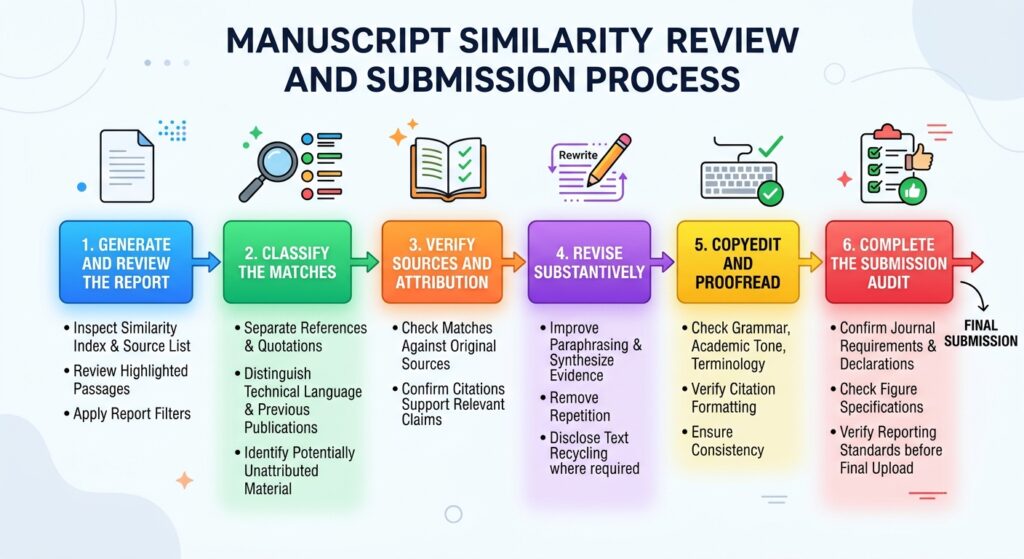
10. Final Pre-Submission Checklist
Before submitting a dissertation or journal manuscript, complete the following checks.
- Review every substantial Turnitin match rather than relying on the overall percentage.
- Verify citations, quotation marks, and reference-list entries against the original sources.
- Rewrite close paraphrases through genuine synthesis without changing the source's meaning.
- Check previously published work for text recycling, disclosure, and permission requirements.
- Retain necessary methodological terminology and ensure that procedures remain reproducible.
- Apply the target journal's current author guidelines and manuscript template.
- Standardize the required citation style, such as APA 7th, IEEE, Vancouver, or Chicago.
- Check headings, abbreviations, tables, figure legends, and supplementary materials.
- Confirm figure quality and resolution requirements; use 300 DPI for raster images when required by the journal.
- Review reporting requirements, including CONSORT, STROBE, or PRISMA when applicable.
- Complete language editing and a final proofread after substantive revisions.
- Save the final manuscript and confirm that all submission files and declarations are complete.
Conclusion: Focus on Academic Integrity, Not Just the Score
Understanding Turnitin similarity index scores versus plagiarism helps researchers make informed, ethical decisions before publication. A high similarity percentage does not automatically indicate misconduct, and a low score does not guarantee that a manuscript is original. What matters is the nature of the matched passages, the accuracy of attribution, the originality of the scholarly contribution, and compliance with the target journal's policies.
Review your similarity report systematically, correct inappropriate overlap, preserve essential technical terminology, and verify every citation. Then refine the manuscript's language, formatting, and presentation to meet professional publishing standards.
Prepare your research for publication with confidence. PaperEdit's academic editing and proofreading services can help you strengthen clarity, consistency, academic tone, and submission readiness while preserving your research meaning and authorial voice.