


Scientific discovery is no longer limited by geography. Researchers from Nigeria, Brazil, Indonesia, and numerous underrepresented regions are producing significant work in medicine, climate science, sociology, biotechnology, and public health. Yet one barrier still dominates global academia: English journals.
The problem is not intelligence. It is visibility.
A researcher may produce groundbreaking findings on infectious diseases, climate adaptation, or educational reform. Still, if the manuscript fails to meet the linguistic and editorial expectations of top-tier English journals, the research often disappears into academic silence. That gap between knowledge creation and publication success is where global inequality in academia becomes painfully obvious.
Today, academic publishing is not just about research quality. It is also about presentation, editorial compliance, language precision, citation structure, and publishing culture. And unless institutions address these structural imbalances, global research geographies will continue to remain invisible inside elite publishing ecosystems.
Why English Journals Still Dominate Global Academia
English remains the dominant language of scientific publishing. According to Wikipedia, most indexed academic literature is published in English, even when the research originates from non-English-speaking countries.
That dominance shapes funding, citations, career progression, and institutional prestige.
Researchers seeking publication in the College English Journal, The English Journal, or the Journal of English for Academic Purposes are often expected to follow highly specific editorial standards that go beyond technical accuracy. Editors evaluate:
- Language fluency
- Clarity of argument
- Structural consistency
- Citation discipline
- Academic tone
- Cultural readability
This creates a silent publishing divide.
Many international researchers possess strong scientific insights but lack access to professional editing systems. As a result, strong manuscripts are frequently rejected before peer review even begins.
This is not a minor issue. It directly affects whose knowledge shapes global policy, healthcare systems, and educational standards.
The Real Publishing Gap Is Editorial, Not Intellectual
A major misconception in academia is that publication rejection equals weak research.
That is often false.
Editors of major English journals routinely reject manuscripts because of readability problems, inconsistent formatting, poor abstract construction, or weak discussion framing. The research itself may still be valuable.
This is especially visible in interdisciplinary and public-health research linked to organizations such as the U.S. Global Change Research Program, where international collaboration is essential for climate and sustainability studies.
The challenge becomes more severe when researchers attempt to publish globally relevant findings using locally trained academic writing styles.
For example:
| Publishing Expectation | Common International Challenge |
| Concise academic tone | Overly descriptive writing |
| Structured argument flow | Fragmented section transitions |
| Native-level grammar | Literal translation issues |
| Journal formatting precision | Inconsistent referencing |
| Reviewer response etiquette | Limited publication mentoring |
This disconnect creates what many academics now describe as a “fair value gap” in research publishing.
The research may hold high academic value, but the publishing system undervalues it because the presentation fails to match elite editorial expectations.
Why Editing Support Has Become Essential in Modern Publishing
Academic editing is no longer optional.
Top journals increasingly expect manuscripts to arrive publication-ready. Editors are overwhelmed with submissions and often use language quality as an early filtering mechanism.
According to Nature, global publishing competition has intensified significantly in recent years, especially after the expansion of AI-assisted research workflows and international submission growth.
This means researchers now compete in an environment where editorial clarity directly affects scientific visibility.
Professional editing helps researchers improve:
- Logical flow
- Technical readability
- Reviewer communication
- Grammar precision
- Journal compliance
- Abstract optimization
- Citation consistency
More importantly, editing protects the integrity of the research itself.
Poor language can distort scientific meaning. In medical and public-health research, that becomes dangerous. A badly framed conclusion or an ambiguous methodology section can lead to misinterpretation of results.
That is why editorial support is increasingly viewed as part of responsible academic publishing rather than cosmetic polishing.
Researchers publishing in the Journal of English for Academic Purposes often discuss how academic writing support influences scholarly participation itself. Language access determines who enters the global conversation.
Explore more on Understanding the Peer Review Process: How It Works and How to Respond.
Global Research Is Expanding Faster Than Publishing Equity
Research production from emerging economies has increased dramatically during the past decade.
Countries across Asia, Africa, and Latin America are contributing heavily to:
- Climate adaptation research
- Epidemiology
- Agricultural sustainability
- AI ethics
- Public-health interventions
- Educational reform studies
However, publication acceptance rates remain uneven across regions.
A report from UNESCO highlights that many researchers in developing nations face structural barriers, including limited editorial mentorship, publishing costs, and weak institutional support systems.
This imbalance affects global knowledge representation.
If only highly polished English-language manuscripts are visible internationally, then entire regional experiences become academically invisible.
For example:
- Local climate data may never influence global climate models.
- Regional disease studies may fail to shape international healthcare policy.
- Indigenous educational methods may remain uncited in mainstream academia.
The issue is not merely linguistic. It is geopolitical.
English journals currently act as gatekeepers of academic visibility.
The Hidden Pressure of Publishing Culture
Publishing is also psychological.
Many researchers from non-English-speaking backgrounds internalize rejection as personal failure rather than systemic imbalance. This creates hesitation, submission anxiety, and long-term disengagement from international publishing.
The pressure intensifies when scholars attempt to publish in prestigious English journals with little institutional mentoring.
Refer to a detailed analysis on Publishing Pressure in Academia: How the System Is Fueling Mental Burnout.
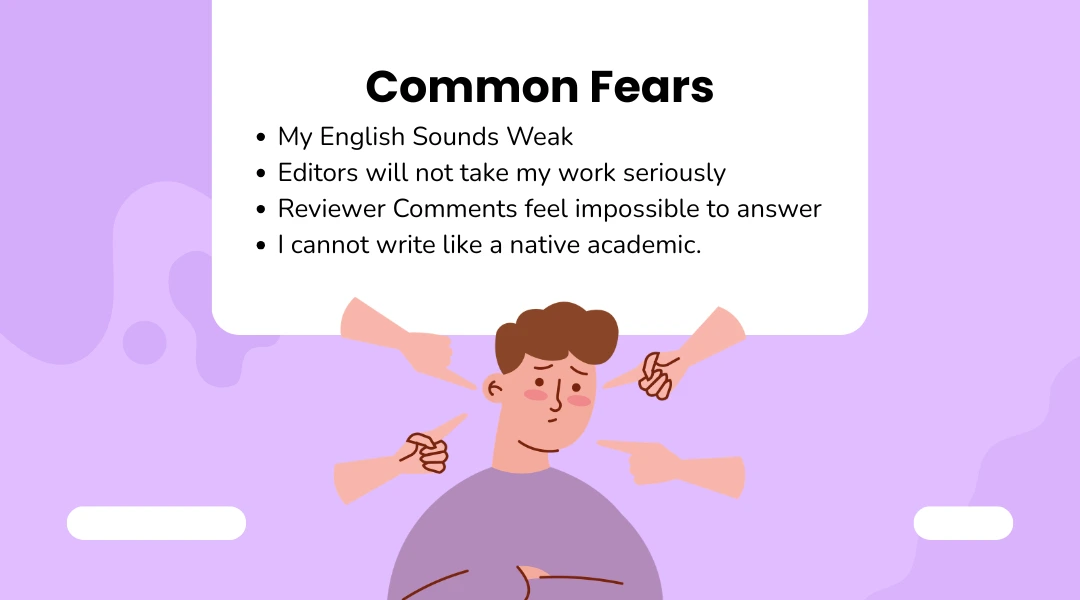
These fears are not irrational. Academic publishing culture can be highly exclusionary.
Even experienced researchers struggle with reviewer politics, editorial bias, and journal positioning strategies.
A manuscript can contain excellent science yet still fail because:
- The framing does not align with journal priorities.
- The discussion section lacks an international context.
- The language feels too localized.
- The introduction does not follow expected rhetorical patterns.
That is why editing support should not be viewed as cheating or academic weakness.
It is infrastructure.
How Ethical Editing Strengthens Academic Integrity
There is an important distinction between ethical editing and unethical manipulation.
Ethical editing improves clarity while preserving the author’s intellectual ownership. It does not fabricate data, rewrite findings dishonestly, or manipulate outcomes.
Responsible editing focuses on:
- Clarity
- Coherence
- Formatting
- Readability
- Language accuracy
- Structural refinement
This aligns directly with academic integrity principles promoted by institutions and editorial organizations worldwide.
The problem arises when editing becomes exploitative or deceptive.
Researchers should avoid:
- Ghostwriting services
- Fake peer-review systems
- AI-generated fabricated citations
- Predatory journals
- Data manipulation assistance
Instead, professional editorial collaboration should function as scholarly support.
This distinction matters because the future of global research depends on trust.
As AI tools become more common in academia, journals are increasingly scrutinizing authenticity, disclosure, and editorial ethics. Transparent editing practices will become even more important over the next decade.
To help you with this, we have a detailed analysis on Combining AI and Human Editing: Best Workflow for Researchers.
Technology Is Reshaping English Journals
The publishing ecosystem is changing rapidly.
AI-assisted editing, multilingual translation systems, and automated formatting tools are reducing some traditional barriers. However, technology alone cannot solve the deeper issue of academic inequality.
A polished sentence generator cannot replace:
- Critical thinking
- Contextual framing
- Research storytelling
- Discipline-specific nuance
- Ethical scholarly communication
Still, technology is helping global researchers gain confidence.
Platforms that support language refinement and journal compliance are making international publishing more accessible than before.
Even publications like the English journal and other academic writing-focused journals increasingly discuss digital literacy, multilingual scholarship, and evolving communication standards.
But there is a danger here too.
If AI-generated academic language becomes overly standardized, journals may begin rewarding polished uniformity over authentic intellectual diversity.
That would create a different kind of imbalance.
The goal should not be to erase global writing identities. The goal should be to make research understandable, credible, and internationally accessible without silencing cultural perspectives.
What Institutions Must Do Next
The responsibility should not fall entirely on individual researchers.
Universities, publishers, and funding bodies must invest in:
- Academic writing training
- Editorial mentorship programs
- Language support centers
- Affordable editing access
- Publication ethics education
- Reviewer training for linguistic inclusivity
Institutions also need to stop treating language proficiency as a proxy for intelligence.
A brilliant epidemiologist from a low-resource region should not lose publication opportunities because of minor grammatical imperfections.
Global academia cannot claim inclusivity while maintaining systems that privilege native-language fluency over research substance.
The publishing world must evolve beyond cosmetic elitism.
Bridging the Gap Requires Structural Change
The conversation around global research and English journals is ultimately about power.
Who gets cited?
Whose work gets published?
Who influences policy?
Who shapes scientific narratives?
Right now, visibility is still uneven.
Researchers from underrepresented regions continue to face disproportionate editorial barriers despite producing increasingly valuable scholarship.
Closing this gap requires more than motivational rhetoric. It requires:
- Ethical editing systems
- Inclusive publishing standards
- Editorial mentorship
- Linguistic accessibility
- Institutional accountability
Global research deserves global visibility.
And until English journals fully recognize that language privilege can distort scientific representation, academic publishing will continue to exclude many of the voices the world most urgently needs to hear.
And, Paperedit is there to serve people from all corners of the world to present their research to a wide global audience with the best possible data presentation and language.
Try our proofreading and formatting services now.
You do the research and leave the rest to us. We are there to bring your idea to the world.
References
- United Nations Educational, Scientific, and Cultural Organization (UNESCO). (2021, June 11). UNESCO science report: The race against time for smarter development (7th ed.). UNESCO Publishing. https://www.unesco.org/en/science-technology-and-innovation/report
- U.S. Global Change Research Program (USGCRP). (n.d.). U.S. Global Change Research Program [Website]. Executive Office of the President. Retrieved May 7, 2026, from https://www.globalchange.gov/