


The rise of AI in academic writing has created a quiet divide in research culture. On one side, you have speed, automation, and scalable drafting. On the other hand, you still have human editorial judgment, scientific accountability, and publication ethics.
The reality in 2026 is simple: neither works alone anymore.
The modern research ecosystem runs on AI and human editing working together—not competing. But most researchers still don’t have a structured workflow. They either overuse AI and risk accuracy issues or rely entirely on human editing and lose efficiency.
This article breaks down a real, publication-ready system used across academic, clinical, and corporate research environments.
Why AI and Human Editing Is Now a Core Academic Workflow
Academic publishing has changed faster in the last five years than in the previous two decades.
AI tools can now:
- Generate first drafts in minutes
- Summarize complex literature
- Rewrite technical paragraphs
- Assist citation formatting
But they still fail at:
- Scientific reasoning consistency
- Ethical interpretation of data
- Discipline-specific accuracy
- Journal compliance alignment
This is why AI and human editing are no longer optional—it is structural.
According to the World Health Organization, AI-assisted outputs in scientific fields must always include human oversight to ensure safety, accuracy, and ethical alignment.
Read more: The Future of Academic Publishing in the AI Era.
The Modern Hybrid Research Workflow Explained
A proper research workflow today is not linear—it is layered.
Instead of “write → edit → submit,” the process now looks like a controlled loop:
Core stages:
- Idea development
- AI-assisted drafting
- Human structural editing
- Technical validation
- Journal formatting and compliance
The key difference is control points. Humans intervene at multiple stages, not just at the end.
Try Paperedit's professional proofreading and formatting services.
Full Workflow Table — AI vs Human vs Hybrid Model
Here is how real-world academic publishing workflows compare:
| Stage | AI-Only Workflow | Human-Only Workflow | Hybrid AI + Human Workflow |
| Idea generation | Fast but generic | Slow but precise | Fast + refined |
| Literature review | Summarized but shallow | Deep but time-heavy | Balanced synthesis |
| First draft | Instant but inconsistent | High quality but slow | AI draft + human correction |
| Methodology accuracy | Weak | Strong | Strong with validation |
| Language clarity | Good but unstable | Excellent | Excellent + scalable |
| Ethical compliance | Not reliable | Fully reliable | Fully verified |
| Publication readiness | Low | High | Very high |
The conclusion is obvious: hybrid workflows dominate every category that matters for publication success.
How to Write a Research Question Using AI Without Losing Precision
One of the most misused AI functions in academia is research question generation.
Knowing how to write a research question properly still determines whether a paper survives peer review.
AI can help you:
- Explore topic variations
- Identify keyword clusters
- Suggest structural framing
But it fails when:
- The scope becomes too broad
- Variables are unclear
- Methodology is not realistic
A strong research question must be:
- Specific (not vague)
- Measurable (operationalized variables)
- Feasible (data can actually be collected)
- Ethical (meets research standards)
This is especially critical in the Postdoctoral Research stage, where research output must meet publication-grade scrutiny.
Learn more from the guide How to Make Your Research Sound ‘Journal-Ready?
AI Editing Tools — Useful, but Misunderstood
There is a growing trend of AI editing apps with no censorship or restrictions being marketed as “complete writing solutions.”
This is misleading in academic environments.
AI tools are useful for:
- Sentence restructuring
- Grammar refinement
- Basic paraphrasing
- Summarization
But they are dangerous when used for:
- Medical claim rewriting
- Statistical interpretation
- Ethical phrasing in clinical studies
- Regulatory documentation
In healthcare-related research, even small wording changes can shift meaning significantly. That’s why institutions like the National Institutes of Health enforce strict guidelines for AI-assisted scientific writing.
Human Editing — The Invisible Quality Layer
Human editing is where academic work becomes publishable.
It is not just proofreading. It is structural intelligence applied to research writing.
Human editors handle:
- Logical flow between sections
- Argument strengthening
- Journal-specific tone alignment
- Citation integrity
- Discipline-specific formatting
An introduction to human services, 9th edition (commonly used in academic training frameworks), highlights how structured human review reduces ambiguity in professional documentation systems.
Clinical and Corporate Research Roles in AI-Human Editing Systems
The integration of AI into research workflows is reshaping job roles—not replacing them.
Key roles include:
Clinical research coordinator jobs
A clinical research coordinator ensures that study documentation, patient data reporting, and publication drafts maintain regulatory compliance.
Corporate research associates
A corporate research associate ensures that business-driven research outputs remain accurate, compliant, and publication-safe.
Both roles increasingly depend on AI-assisted drafting—but human validation remains mandatory.
These roles operate under strict standards influenced by organizations like the World Medical Association, which emphasizes ethical responsibility in scientific reporting.
Analyze objectively with the help of this: Should Medical Students Invest in Editing Services?
Save File Editing and Version Control — The Silent Failure Point
Most research failures don’t happen in writing—they happen in file management.
Save file editing issues include:
- Overwritten drafts
- Lost version history
- Citation mismatches across revisions
- Conflicting co-author edits
Modern research workflows now include:
- Structured version naming systems
- AI-assisted change tracking
- Human verification checkpoints
Publishing standards from Elsevier strongly emphasize version control integrity before submission.
Step-by-Step Hybrid Workflow for Researchers (Practical Model)
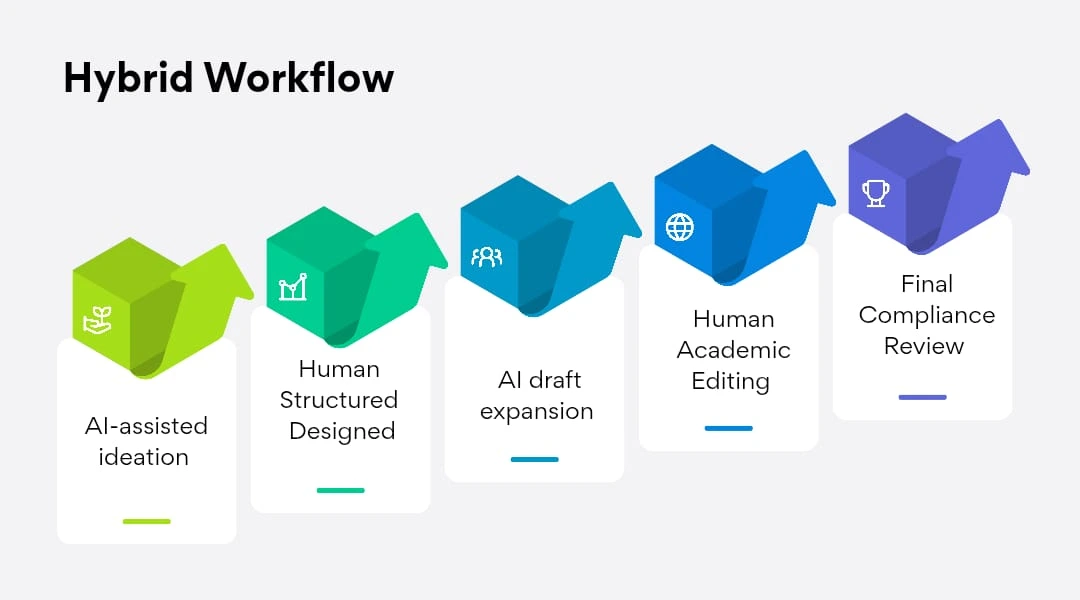
Here is the real-world system used in high-quality academic publishing:
Phase 1: AI-Assisted Ideation
- Topic exploration
- Keyword clustering
- Draft outline generation
The Phase 2: Human Structural Design
- Research question refinement
- Methodology validation
- Argument structuring
Phase 3: AI Draft Expansion
- Paragraph expansion
- Grammar polishing
- Basic paraphrasing
4th Phase: Human Academic Editing
- Scientific accuracy check
- Flow correction
- Journal alignment
Phase 5: Final Compliance Review
- Citation verification
- Formatting corrections
- Ethical compliance validation
Visit Now: Paperedit.
Why Hybrid Editing Produces Better Publication Outcomes
The hybrid model works because it solves the weaknesses of both systems.
AI provides:
- Speed
- Scale
- Drafting efficiency
Humans provide:
- Judgment
- Ethical oversight
- Disciplinary accuracy
Together, they produce manuscripts that are:
- Faster to produce
- More accurate
- More publishable
- Less likely to be rejected
This is why even major research institutions working with World Health Organization frameworks still require human validation in AI-assisted outputs.
Learn about the strengths and weaknesses of each methodology from the guide "AI vs Human Editing: Which Is Better for Your Manuscript in 2025?"
Future of Academic Writing — Collaboration, Not Replacement
The future is not AI replacing researchers.
It is AI becoming a constant assistant layer inside research workflows.
But one truth remains unchanged:
AI can generate text.
Only humans can validate truth.
That distinction is what separates publishable research from rejected manuscripts.
External References Used