

Medical students are trained to diagnose, not to write like journal editors. Yet in today’s hyper-competitive academic environment, your ability to communicate research clearly can define your career trajectory just as much as your clinical skills.
So the real question isn’t can you write your own paper?
It’s this: should medical students invest in editing services—or risk submitting work that doesn’t meet publication standards?
Let’s break it down with clarity, not fluff.
The Reality: Medical Writing Is Not Clinical Thinking
Medical education focuses heavily on knowledge acquisition—anatomy, pathology, pharmacology—but almost no structured training is provided in scientific writing.
Even widely used resources like Introduction to Medical Terminology, Second Edition, or Medical Terminology, 9th Edition, by Davi Ellen Chabner, build vocabulary, not writing precision.
That gap matters.
Because journals don’t evaluate how much you know.
They evaluate how effectively you communicate what you know.
Poor structure, weak flow, inconsistent terminology—these are enough to get a paper rejected before peer review even begins.
To stay safe from committing these errors, refer to these guides:
- Paragraph Structure in Academic Writing
- How to Improve Logical Flow in Research Papers
- 4 Types of Language Errors in Research Papers (With Examples)
According to guidelines from the International Committee of Medical Journal Editors (ICMJE), clarity, accuracy, and transparency are non-negotiable standards in scientific publishing.
And most students are simply not trained for that level of writing.
Why the Stakes Are Higher Than Ever
A decade ago, publishing during medical school was optional. Today, it’s a differentiator.
Residency programs, research fellowships, and even scholarship committees now evaluate:
- Number of publications
- Quality of journals
- Authorship position
- Clarity of scientific contribution
In competitive specialties, your publication record is often the deciding factor between two equally qualified candidates.
This shift has created a pressure point: students are producing research faster—but not necessarily better.
And when quality doesn’t match ambition, rejection rates rise.
That’s where editing services enter the equation—not as shortcuts, but as performance enhancers.
What “Medical Editing” Actually Fixes
There’s a misconception that medical editing is just grammar correction. That’s outdated.
Professional medical editing targets:
- Logical flow of arguments
- Clarity of research objectives
- Consistency in terminology (especially when referencing texts like Medical Terminology for Health Professions, 9th edition)
- Statistical presentation and readability
- Journal-specific formatting
- Tone alignment with academic standards
It also ensures compliance with the publication ethics outlined by organizations like COPE (Committee on Publication Ethics).
This is critical—because journals are increasingly strict about ethical reporting and transparency.
Get to know more with our guide: Ethical Challenges in Multi-Center Research.
The Hidden Cost of Not Investing
Let’s be direct: skipping editing isn’t saving money—it’s increasing risk.
Here’s what medical students often underestimate:
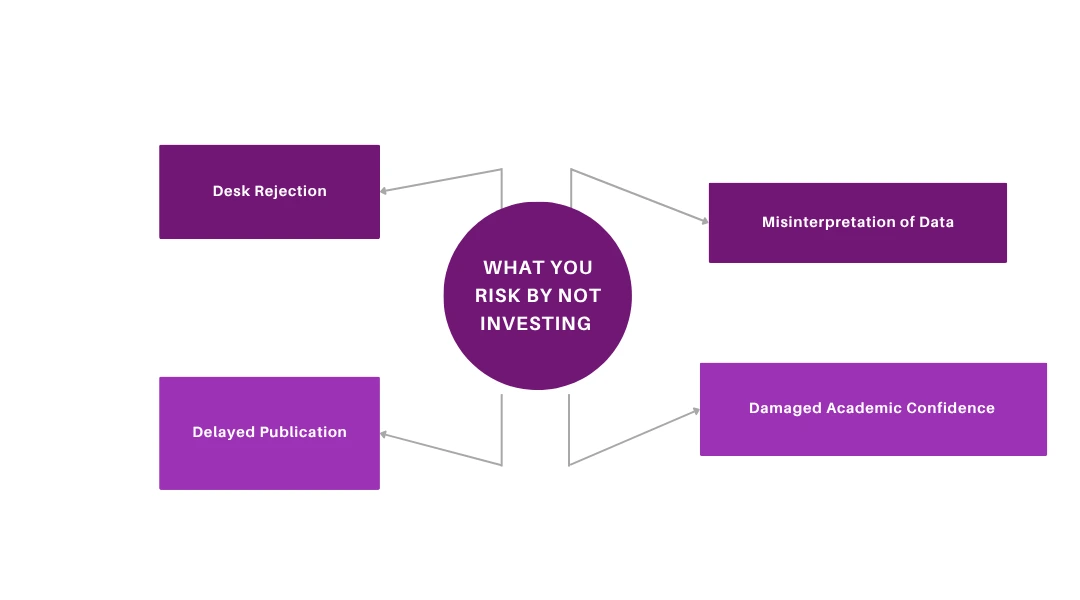
1. Desk Rejection
A poorly written manuscript can be rejected within days, regardless of research quality.
Editors don’t have time to decode unclear writing. If your paper isn’t readable on the first pass, it’s out.
2. Misinterpretation of Data
Ambiguous language can distort your findings, especially in clinical or statistical sections.
A single poorly written sentence in the results section can change how reviewers interpret your entire study.
3. Delayed Publication
Revisions take weeks or months, especially when feedback repeatedly targets writing issues instead of scientific content.
4. Damaged Academic Confidence
Repeated rejection doesn’t just slow progress—it impacts your motivation and future research output.
A report from NCBI highlights that language quality significantly influences peer-review outcomes, particularly for early-career researchers.
When Should Medical Students Invest?
Not every assignment needs professional editing. But certain situations make it a strategic move, not a luxury.
You should seriously consider editing if:
- You’re submitting to a peer-reviewed journal
- English is not your first language (Read Top Mistakes Non-Native English Speakers Make in Scientific Proofreading)
- You’re writing a systematic review or meta-analysis
- Your manuscript has already been rejected once
- You’re targeting high-impact journals
- You’re collaborating internationally and need a standardized language
In these cases, editing is not optional—it’s competitive positioning.
Editing vs Learning: Are You Skipping Skill Development?
This is where many students hesitate.
“If I outsource editing, won’t I stop improving?”
Fair concern.
But it’s based on a false assumption.
Editing services, when used correctly, are learning tools.
You don’t just submit your paper—you analyze the changes:
- How sentence structure improves clarity
- How terminology becomes consistent
- How arguments are strengthened
- How redundancy is eliminated
Over time, this exposure rewires your writing instincts.
Think of it as guided refinement, not replacement.
Even top researchers rely on editors—not because they can’t write, but because they understand objectivity improves quality.
The Financial Question: Worth It or Not?
Medical students often ask: How to invest as a medical student without wasting money?
Here’s the truth:
Spending on editing is not consumption—it’s academic investment.
But that doesn’t mean you should spend blindly.
Smart budgeting strategies:
- Use editing only for high-stakes submissions
- Split costs among co-authors when possible
- Avoid ultra-cheap services that compromise quality
- Prioritize quality over speed
Compare the outcomes:
| Without Editing | With Professional Editing |
| Higher rejection risk | Higher acceptance probability |
| Longer revision cycles | Faster turnaround |
| Weak presentation | Strong academic voice |
| Lost opportunities | Improved publication record |
Publications are currency in medicine.
They influence residency placements, scholarships, and research funding.
From that perspective, editing services are not an expense—they’re leverage.
Ethical Boundaries: What Editing Should NOT Do
Let’s be clear—there’s a line.
Ethical editing:
- Improves language and structure
- Enhances clarity
- Aligns with journal standards
Unethical editing:
- Alters data or results
- Adds or removes authorship
- Manipulates findings
- Fabricates citations or references
The World Health Organization emphasizes integrity in research reporting, making it clear that editing must never compromise scientific accuracy.
If a service crosses that line, it’s not editing—it’s misconduct.
And misconduct doesn’t just get papers rejected—it can end careers before they begin.
Why Medical Terminology Alone Isn’t Enough
Many students rely heavily on resources like:
- Medically Unlikely Edit Medical Terminology for health professions, 9th edition
- Standard terminology textbooks
These help with vocabulary—but they don’t teach:
- Narrative flow
- Argument structuring
- Cohesion across sections
- Reader engagement
- Critical discussion framing
Knowing the term “myocardial infarction” doesn’t mean you can write a compelling discussion section about it.
That’s the difference between knowledge and communication.
The Role of Editing in Global Medical Publishing
Here’s something often overlooked:
Medical research is global—but English dominates publishing.
This creates an uneven playing field.
Students from non-English-speaking backgrounds face:
- Higher rejection rates due to language
- Bias in peer review
- Misinterpretation of otherwise strong research
Editing services help level that field.
They don’t change your science—they ensure your science is understood.
In that sense, editing is not just a personal advantage—it’s a tool for academic equity.
Explore more on this topic with the guide: Top Mistakes Non-Native English Speakers Make in Scientific Proofreading.
Smart Strategy: How to Use Editing Services Effectively
If you decide to invest, do it strategically.
1. Don’t wait until submission day
Editing should be part of your drafting process, not a last-minute fix.
2. Choose domain-specific editors
Medical writing requires subject familiarity, not just language expertise.
3. Review edits actively
Don’t accept changes blindly—learn from them.
4. Combine with self-improvement
Use editing alongside writing practice, not as a replacement.
For example, while preparing manuscripts, students often refine drafts using guidance from
professional academic editing services to ensure clarity before journal submission.
Similarly, understanding what manuscript editing actually involves helps students set realistic expectations.
Many researchers also improve submission quality through scientific editing services designed specifically for journal standards. For longer academic work, consistency is maintained with support from
thesis editing experts.
And when working on early drafts, structured help like research paper editing assistance can significantly improve clarity and coherence.
The Competitive Edge Most Students Ignore
Here’s the uncomfortable truth:
Two students can conduct equally strong research, but the one with better presentation skills gets published.
That’s it.
In a saturated academic space, writing quality is a filter.
Editors and reviewers are not just evaluating science—they’re evaluating readability, structure, and professionalism.
Students who invest early in clarity, structure, and professional editing gain:
- Faster publication cycles
- Stronger CVs
- Better research visibility
- Increased collaboration opportunities
And once you build a track record of well-written publications, future submissions become easier—not harder.
Final Verdict: Investment or Unnecessary Expense?
Let’s cut through the noise.
If you’re serious about research, publications, and long-term academic growth:
Yes—medical students should invest in editing services.
Not blindly. Not for everything.
But strategically, when the stakes justify it.
Because in medicine, being right isn’t enough.
You have to be understood—and published.