

For researchers trying to publish their first paper, one question appears almost immediately: Where can you find free Scopus indexed journals?
The pressure to publish is real. PhD applicants, early-career researchers, and academics all need indexed publications to build credibility. Go through our guide on Publishing Pressure in Academia: How the System Is Fueling Mental Burnout. But many journals charge high article processing fees that create barriers, especially for researchers from developing academic systems.
Here’s the reality: publishing in Scopus does not automatically mean paying high fees. Many journals indexed in Scopus still operate under traditional subscription models where authors publish for free.
The challenge is not the absence of free journals — it’s knowing how to identify legitimate ones. This guide explains how to locate them ethically, verify their indexing status, and avoid predatory traps.
Also decide with our guide on How to Confirm Your Research Idea Hasn’t Been Done.
Understanding What “Free Scopus Indexed Journals” Really Means
Before searching for journals, you need to understand how the Scopus ecosystem works.
Scopus itself is a large abstract and citation database managed by Elsevier. It indexes thousands of peer-reviewed journals across disciplines.
A journal being indexed in Scopus means:
- It passed a strict quality evaluation process
- It follows peer-review standards ( Go through Understanding the Peer Review Process: How It Works and How to Respond)
- It meets citation and publishing benchmarks
You can read about the evaluation process through the Content Selection & Advisory Board, which reviews journals before indexing.
Importantly, Scopus does not control journal pricing. That means:
- Some journals charge Article Processing Charges (APCs)
- Others publish completely free of cost for authors
These are the journals researchers are usually trying to find.
For a broader overview of the database itself, see Scopus.
Is Scopus Free to Use?
A common misconception among early researchers is the question: “Is Scopus free to use?”
The short answer: not fully.
Scopus is primarily a subscription-based research database used by universities, research institutes, and libraries. Access usually comes through institutional subscriptions.
However, researchers can still access limited features without paying:
- Some universities provide remote access for students
- Author profiles and metrics can be publicly viewed
- Journal indexing status can be checked through official listings
You can explore how Scopus operates through the database description on Scopus or through summaries available on Wikipedia.
For most researchers, university library portals remain the main free access route.
Step-by-Step: How to Access the Scopus Database for Free
Even without personal subscriptions, there are legitimate ways to check journals.
1. Use the Official Scopus Sources List
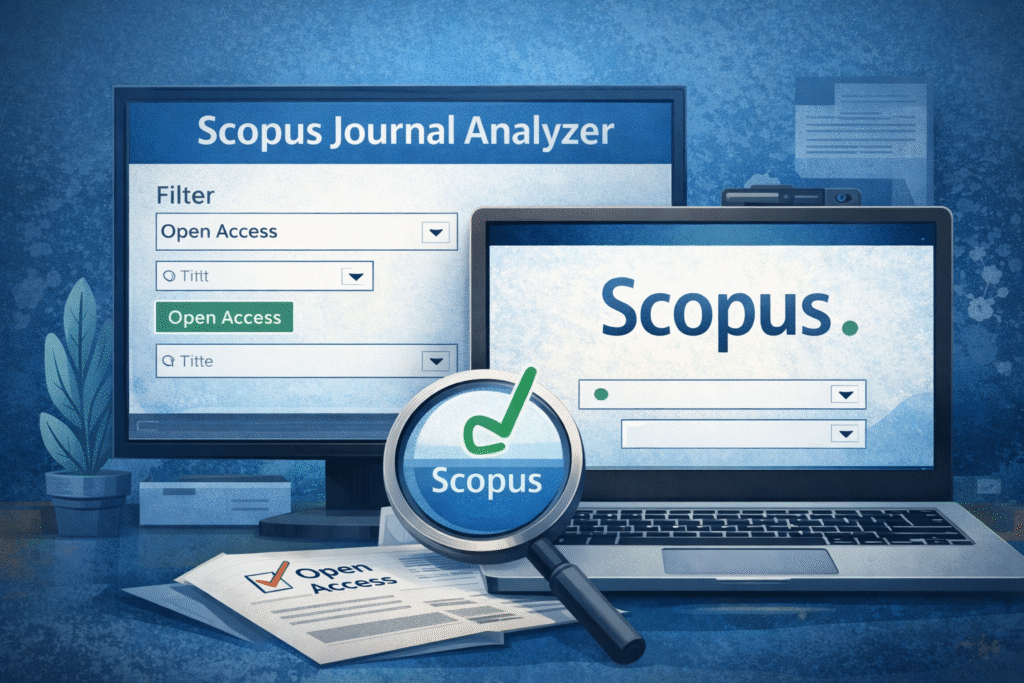
The most reliable way to verify journals is the Scopus Sources List.
Researchers can download the official list from the Scopus website and filter journals by:
- subject area
- country
- publisher
- open access status (Get to know Open Access vs. Traditional Publishing: Which One is Right for You?)
This file essentially works as a master scopus indexed journal list.
It also helps you verify the scopus indexed journals list 2025, which updates periodically.
Learn about Scopus Quartiles Explained (Q1, Q2, Q3, Q4).
2. Use University Library Access
Most universities subscribe to Scopus.
If you are affiliated with an institution:
- log into your university library portal
- open the Scopus database
- search journals by subject keywords
University access often allows you to explore:
- citation metrics
- journal quartiles
- submission guidelines (Explore how to Publish Research as a Student)
For details about global research databases and citation systems, organizations like National Institutes of Health discuss research indexing standards.
3. Use Open Access Directories
Many free Scopus indexed journals are also listed in the Directory of Open Access Journals.
DOAJ is one of the most reliable open-access databases in academia.
You can:
- search journals by discipline
- verify editorial policies
- check APC policies
However, remember one key point:
Not all DOAJ journals are indexed in Scopus.
Always cross-check them with the official Scopus sources list.
How to Identify Free Journals Inside the Scopus Indexed Journal List
Explore more through our blog How to Check If a Journal is Scopus Indexed and Why It Matters?
Once you download the scopus indexed journal list, the next challenge is filtering it.
Look for these indicators:
Journals without APCs
Some subscription journals charge readers rather than authors.
These typically show:
- no article processing charges
- traditional copyright transfer agreements
These are usually the best free publishing options.
Society-Published Journals
Many journals run by academic societies operate without author fees.
Examples include journals supported by:
- scientific societies
- universities
- research foundations
You can verify publishing models through academic directories or databases like UNESCO, which frequently publishes research policy reports on open science.
Hybrid Journals
Hybrid journals offer two options:
- free publishing (subscription route)
- paid open access publishing
Choosing the subscription route often allows authors to publish without paying.
How to Avoid Fake “Scopus Indexed” Journal Lists
This is where many researchers make costly mistakes.
The internet is full of fake lists claiming Scopus indexing.
Predatory journals often advertise:
- guaranteed publication
- extremely fast review
- fake indexing claims
According to reporting from Committee on Publication Ethics, predatory publishing has become a major threat to academic integrity.
To avoid them:
Always verify journals through:
- official Scopus sources list
- publisher websites
- indexing confirmation inside Scopus
Never trust lists hosted on random websites.
Journaling Techniques That Improve Acceptance Chances
Finding the right journal is only half the process.
Acceptance depends heavily on how your research is written and structured.
Here are effective journaling techniques used by experienced researchers:
Write With Journal Scope in Mind
Editors reject many papers simply because they fall outside the journal’s scope.
Before submission:
- read at least 5 recent articles from the journal
- match your topic to their research themes
Structure the Paper for Clarity
Most high-quality journals expect the standard research structure:
- Introduction
- Literature Review
- Methodology
- Results
- Discussion
- Conclusion
Clear structure significantly improves editorial screening success.
Prioritize Research Transparency
Transparency is increasingly important in academic publishing.
Organizations like World Health Organization encourage open and reproducible research standards.
This means clearly reporting:
- datasets
- research methods
- ethical approvals
Transparent research builds credibility and improves acceptance odds.
Why Free Scopus Indexed Journals Matter for Early Researchers
For early-career academics, free journals remove a major financial barrier.
Publishing without APCs allows researchers to:
- build a citation record
- strengthen PhD applications
- establish an academic profile
In many developing research environments, access to free Scopus indexed journals is essential for equitable academic participation.
But remember:
Free publishing should never compromise quality.
Your priority should always be reputable journals with transparent peer review.
Final Thoughts
The search for free Scopus indexed journals does not need to be complicated.
Researchers simply need to rely on official data sources rather than random internet lists.
The process is straightforward:
- Download the official Scopus sources list
- Filter journals by discipline and access model
- Verify indexing status inside Scopus
- Review submission guidelines carefully
Academic publishing is competitive, but ethical and strategic journal selection can significantly improve your chances of success.
The goal isn’t just to publish — it’s to publish in journals that genuinely strengthen your academic reputation.