


Academic publishing is not experiencing incremental change. It is undergoing structural recalibration.
AI in Academic Publishing is no longer a background utility correcting grammar or flagging plagiarism. It is influencing editorial triage, peer review workflows, impact measurement, research discoverability, and institutional evaluation systems. The transformation is deep, infrastructural, and irreversible.
Yet the real challenge is not technological capability. It is governance.
Because AI transformation is a problem of governance, and governance defines credibility in science.
AI in Academic Publishing: Is AI Rewiring Editorial Decision-Making
Editorial offices now use AI-assisted screening tools to evaluate submissions before a human editor reads a single paragraph. These systems detect:
- Statistical inconsistencies
- Image duplication (Read How Image Manipulation Accidents Trigger Retractions)
- Citation manipulation ( Explore: The Role of Google Scholar Citations in Academic Reputation)
- Plagiarism and text recycling (Get to know: Avoiding Plagiarism Without Losing Your Voice)
- Language clarity issues (View 4 Types of Language Errors in Research Papers (With Examples)
Organizations like the International Committee of Medical Journal Editors are updating authorship and disclosure standards to address AI-assisted contributions. Similarly, ethical guidance from the World Health Organization emphasizes transparency and explainability in AI systems used within health research ecosystems.
The shift is operationally efficient. But efficiency without oversight is destabilizing.
Editorial algorithms may inadvertently favor certain writing styles, institutional affiliations, or geographic regions. If AI triage decisions lack transparency, peer review authority weakens. Journals must therefore publish algorithm governance statements — clarifying how AI tools are trained, audited, and monitored.
The integrity of scholarship depends not on automation, but on accountability.
The Evolution of Peer Review: From Expert Judgment to Hybrid Intelligence
Peer review has always evolved. From informal correspondence among scientists to structured editorial panels, its function remains constant: to protect scientific rigor. Historical developments in peer review are documented extensively in resources such as Wikipedia.
Today, however, peer review is becoming hybrid.
AI now:
- Suggests potential reviewers based on citation networks
- Summarizes manuscripts for editors
- Flags methodological red flags
- Detects statistical anomalies
This introduces a new leadership paradigm for the peer academic leader.
Editors must now interpret machine-generated insights while retaining human judgment. They are not being replaced — they are being redefined.
Digital literacy becomes an editorial competency. Understanding bias auditing, model transparency, and algorithmic limitations becomes part of the role.
For researchers planning a publication strategy, understanding these editorial shifts is now an essential academic planner function — not optional career advice.
Reinventing the Academic Performance Indicator
For decades, the academic performance indicator revolved around citation counts and journal impact factors. But what is an academic performance indicator in an AI-dominated publishing ecosystem?
It is no longer a static metric. It is a dynamic, multidimensional profile.
AI-driven analytics platforms now measure:
- Citation velocity (not just total citations)
- Interdisciplinary influence
- Policy citations
- Clinical translation impact
- Data reuse frequency
- Public engagement metrics
This evolution changes how institutions evaluate academic performance. Hiring committees, funding agencies, and promotion boards increasingly rely on analytics dashboards.
Below is a simplified comparison of traditional versus AI-enhanced performance indicators:
| Dimension | Traditional Model | AI-Enhanced Model |
| Citation Tracking | Total citation count | Citation growth velocity & network influence |
| Journal Quality | Impact factor | Multi-metric journal analytics |
| Research Impact | Academic citations only | Policy, media, clinical, and dataset impact |
| Evaluation Frequency | Periodic review | Real-time dashboard monitoring |
| Transparency | Public metrics | Often proprietary algorithms |
The danger lies in opacity. If performance systems rely on proprietary AI models, academic careers may be shaped by metrics that researchers cannot audit or challenge.
Governance must ensure that AI-enhanced academic performance indicator systems remain transparent, interpretable, and equitable.
Authorship in the Age of AI in Academic Publishing: Disclosure Is Non-Negotiable
Can AI be an author?
No.
Authorship requires accountability, responsibility, and intellectual ownership. Major publishers have clarified this stance. For example, policies reported by Nature require full disclosure when AI tools contribute to manuscript preparation.
However, the ethical challenge is subtler.
Consider these questions:
- Should AI-assisted language refinement be disclosed?
- What about AI-generated data visualizations?
- If AI suggests structural edits, is that an intellectual contribution?
Transparency frameworks must expand beyond binary declarations. Journals need standardized reporting categories for AI involvement — similar to conflict-of-interest disclosures.
Without structured disclosure norms, trust becomes negotiable. And academic publishing cannot afford negotiable trust.
Digital Ecosystems and the Rise of Integrated Research Platforms
AI in Academic Publishing is not an isolated tool. It is part of an integrated digital ecosystem.
Publishing platforms increasingly combine:
- Manuscript submission portals
- Reviewer management systems
- Institutional analytics dashboards
- Career tracking modules
Platforms illustrate how digital publishing environments can integrate research tools, annotations, and analytics within one system.
This integration resembles an advanced academic planner — mapping research productivity, journal engagement, and career milestones in real time.
But integration also centralizes data.
When research output, career analytics, and institutional evaluations converge within AI-driven platforms, governance must prevent surveillance-style performance management. Researchers should not feel algorithmically monitored at every step.
Academic freedom requires digital restraint.
Global Equity: The Structural Risk of Biased Data
AI systems learn from historical data. Academic publishing data is disproportionately Western and English-dominant.
This creates structural bias risks:
- Non-Western phrasing flagged as “lower quality.”
- Citation networks amplifying elite institutions
- Underrepresented regions receive lower visibility.
The solution is not abandoning AI. It is reforming its training infrastructure.
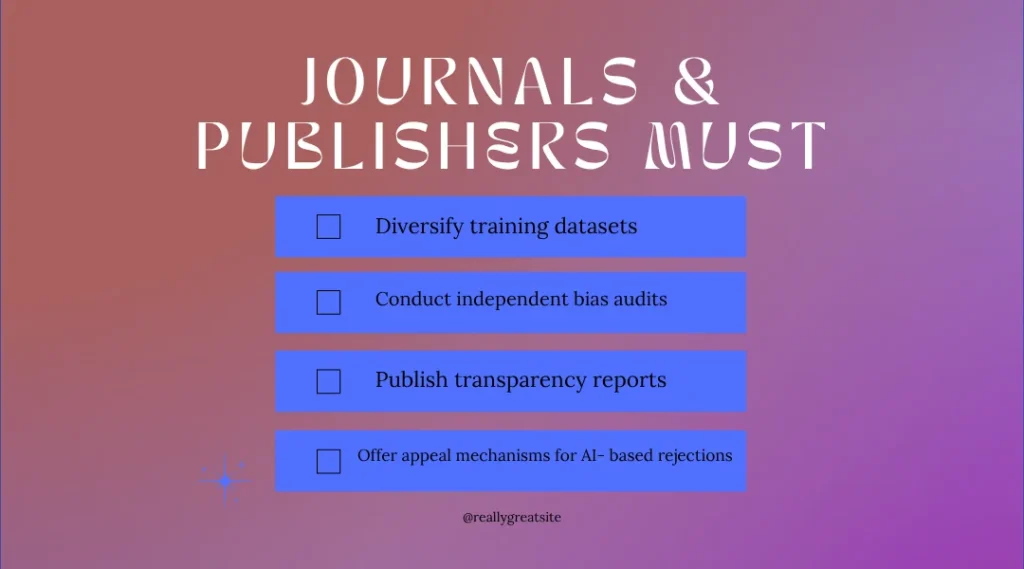
Global research equity depends on inclusive algorithm design.
The Pew Research Center has highlighted broader societal implications of AI-driven systems, emphasizing that governance frameworks must evolve alongside technological adoption.
Academic publishing is no exception.
Economic Recalibration: From Prestige to Infrastructure
Traditional publishing relied on prestige hierarchies — print circulation, subscription models, and journal brand dominance.
AI shifts power toward infrastructure.
Control now lies in:
- Data architecture
- Cloud security
- Metadata indexing
- API interoperability
- Analytics ownership
Institutions that control research metadata shape discoverability. Discoverability shapes citation patterns. Citation patterns shape academic performance indicators.
This is not a cosmetic change. It is structural power redistribution.
Universities must invest not only in research production but in digital governance expertise. Data scientists, ethicists, and editorial leaders must collaborate.
Because infrastructure defines influence in the AI era.
The Role of Governance: Beyond Policy Statements
Saying “we use AI responsibly” is insufficient.
Effective governance requires:
- Transparent disclosure policies
- Independent auditing of AI tools
- Clear authorship contribution standards
- Appeals processes for automated decisions
- Bias monitoring frameworks
- Cross-border regulatory collaboration
Editorial boards must include digital ethics advisors. Funding agencies must require algorithm transparency in publishing platforms they endorse.
The peer academic leader of tomorrow is not only a subject-matter expert. They are a steward of ethical digital integration.
The Road Ahead: What Will Actually Change?
Within the next decade, we can expect:
- AI-assisted peer review becoming standard practice
- Real-time research performance dashboards
- Mandatory AI contribution disclosure statements
- Open algorithm transparency reporting by journals
- Hybrid editorial boards combining subject experts and data scientists
The meaning of the academic performance indicator will evolve continuously. The academic planner will become digital, predictive, and analytics-driven.
But credibility will remain human.
AI can accelerate knowledge dissemination. It cannot replace responsibility.
Final Reflection: Control the Governance, Protect the Future
AI in Academic Publishing is inevitable. Resistance is futile — but passivity is dangerous.
If institutions proactively build transparent governance models, AI can:
- Enhance methodological rigor
- Detect misconduct faster
- Improve global accessibility
- Expand impact measurement beyond citations
If governance fails, AI could:
- Institutionalize bias
- Opaque career evaluation systems
- Erode peer review trust
- Commercialize research metrics
The future of academic publishing will not be determined by code alone.
It will be determined by how responsibly we regulate, audit, and lead technological integration.
Because credibility is built by governance — not algorithms.
Explore further on AI in Academic Writing: How It’s Changing Research & Publishing