


A high-authority editorial for academic writers who are done guessing why their work keeps getting rejected.
Why Rejection Keeps Happening — And Why It's Not Always About the Research
You did the study. Also, you ran the analysis. You wrote the paper. And then — reject.
If you've received that dreaded editor's verdict more than once, you're not alone. Manuscript rejection rates at top-tier journals hover between 70% and 95%. But here's what most researchers don't hear: the majority of rejections are not about weak data. They're about writing patterns in rejected papers — structural, rhetorical, and stylistic habits that signal to reviewers (consciously or not) that a paper isn't ready for publication.
This article breaks down exactly what those patterns look like, why they kill manuscripts, and how serious academic writers can course-correct before hitting submit. If you've ever spiraled through the reject-reject-reject cycle and couldn't figure out why, this one's for you.
For more info, read How to Diagnose Problems in Your Manuscript?
What Is a "Writing Pattern" in Academic Context?
Before we go further, let's define the term. A definition writing pattern in academic work refers to a recurring structural or rhetorical approach a writer uses across sections — in how they frame arguments, present evidence, transition between ideas, or signal their contribution.
Not all writing patterns are bad. In fact, well-established patterns for college writing and graduate-level research communication exist precisely because they work. Resources like Patterns for College Writing (16th edition) and its earlier iterations have long taught writers how to use expository, analytical, and argumentative modes effectively. The problem is when writers fall into default patterns — habits adopted unconsciously — that undermine their paper's authority, clarity, or originality.
Good academic writing is intentional. Rejected academic writing is usually habitual.
The 8 Most Common Writing Patterns in Rejected Papers
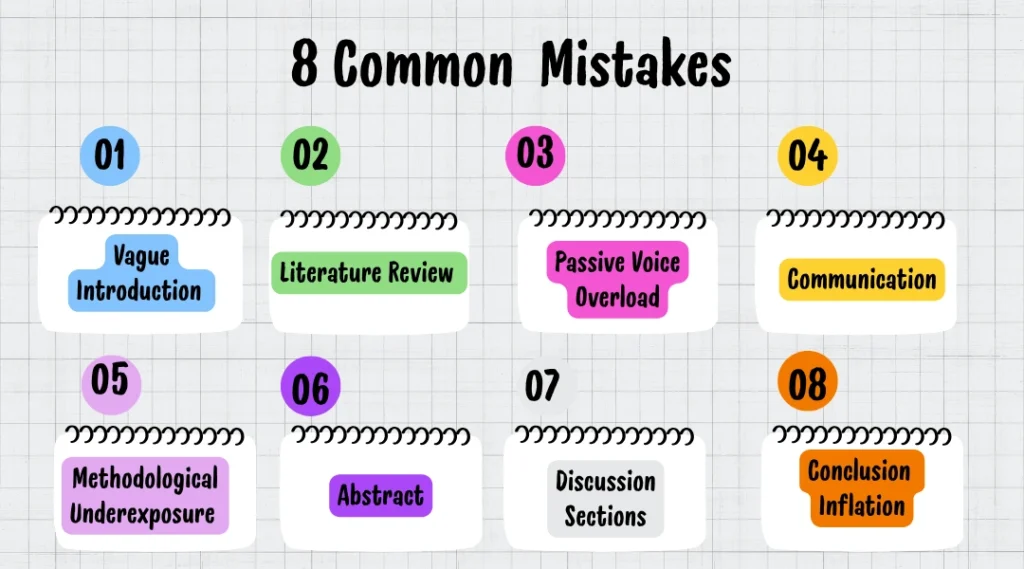
1. The Vague Introduction That Never Lands
One of the most consistent patterns for writing that leads to desk rejection is an introduction that fails to establish a problem with urgency. Writers often open with sweeping statements like "Research has long explored..." or "In recent years, scholars have..." — sentences that say nothing specific.
Editors read hundreds of submissions. They are not patient. If your first paragraph doesn't make them feel the gap your study fills, they'll move on.
What works instead: Open with the specific problem, state what's unknown, and signal your unique contribution — all within the first 200 words. That's the standard. Anything less is a signal that the writer hasn't fully internalized their own argument.
2. A Literature Review That Summarizes Instead of Synthesizes
This is perhaps the most widespread of all writing patterns in rejected papers, and it plagues even experienced researchers.
Summarizing means you describe what Study A found, then what Study B found, then what Study C found. Synthesizing means you identify the conversation between those studies — the agreements, contradictions, and gaps — and position your own work within it.
Journals want synthesis. They want to see that you understand the intellectual landscape deeply enough to intervene in it. A literature review that reads like an annotated bibliography tells reviewers you're reporting, not thinking.
3. Passive Voice Overload
There's a long-running myth in academic writing that passive voice signals objectivity. It doesn't. It signals evasion.
Overuse of constructions like "it was found that", "data were collected", or "it has been argued" creates distance — not only between the reader and the research, but between the writer and their own argument. According to APA Publication Guidelines, use of active voice is explicitly encouraged in scientific writing because it improves clarity and directness.
Passive voice has a place. But when it dominates an entire manuscript, it makes the writing feel limp. Reviewers pick up on this intuitively even when they don't articulate it.
4. The Floating Claim — Assertions Without Anchors
A floating claim is an argument that appears without sufficient evidence, context, or citation. It shows up constantly in the Discussion sections of rejected papers:
"These findings suggest significant implications for policy."
Which policy? What kind of implications? Compared to what baseline? For whom?
This pattern for writing mistakes assertion for argument. A claim in academic writing must be anchored — to data, to prior literature, to a theoretical framework, or to a logical chain of reasoning. Floating claims feel like intellectual hand-waving, and reviewers — especially those in fields like public health, education research, or social sciences — will mark them immediately.
5. Methodological Underexposure
Rejected papers frequently undersell or under-explain methodology. Writers assume readers will infer what they did; reviewers assume writers didn't fully think it through.
Your methods section is not a bureaucratic formality. It is the section that establishes the credibility of everything that follows. If a reviewer can't clearly understand why you chose your sample size, your instrument, your analytical approach — doubt creeps in. That doubt becomes a rejection.
This is especially relevant now as human-AI collaboration patterns in AI-assisted academic writing become more common. When AI tools are used in data processing, literature screening, or even drafting, the methods section must address this transparently. Journals are increasingly alert to opacity in this space, and under-disclosed AI involvement is fast becoming a grounds for rejection or retraction.
6. An Abstract That Buries the Contribution
Your abstract is your entire paper in 200–300 words. It is not a teaser. Nor, it is an outline. It is a compression of your study's most important elements: problem, method, key findings, and significance.
The rejected-paper version of an abstract typically front-loads background and methodology and saves the actual findings for the final line — or omits them entirely. This is backwards. Reviewers and readers want to know what you found and why it matters within the first few sentences.
Think of your abstract the way a journalist thinks of a lede. Lead with the news. The context can follow.
7. Discussion Sections That Don't Discuss
A Discussion section that simply restates findings in different words is one of the most common writing patterns in rejected papers at the revision-rejection stage.
Discussion ≠ Summary. Discussion means engaging with your findings in relation to:
- What the existing literature predicted
- Where your results align, diverge, or complicate prior work
- What your findings mean theoretically and practically
- What the honest limitations are
- What future research should address
If your Discussion reads as a cleaned-up version of your Results, you haven't written a Discussion. You've written a second Results section, and editors know the difference.
8. Conclusion Inflation
The conclusion is not where you expand your claims — it's where you consolidate them. Rejected papers frequently try to make the conclusion do work the rest of the paper hasn't done: introducing new ideas, speculating beyond the data, or suddenly broadening scope.
A strong conclusion returns to the original problem, confirms whether (and how) it was addressed, and closes with a precise statement of contribution. It's clean. It's bounded. It doesn't overreach.
The Reject-Reject-Reject Spiral: What It's Actually Telling You
If you're stuck in a repeated cycle — submit, reject, resubmit, reject again — it's worth asking a hard question: Is this a journal-fit problem or a writing problem?
How to deal with rejection in academic publishing is less about emotional resilience (though that matters too) and more about systematic diagnosis. Every rejection letter contains information. A desk rejection before peer review usually signals a structural or fit issue. A rejection after review with detailed comments signals that the research has merit but the writing or framing failed.
Most writers treat rejection as an endpoint. Effective academic writers treat it as a diagnostic tool.
According to a study cited by Clinicapress' guidance for authors, papers that are revised in response to reviewer feedback and resubmitted — even to a different journal — have significantly higher acceptance rates than first-round submissions. The revision process, when approached analytically, is itself a writing improvement cycle.
A Diagnostic Table: Writing Patterns vs. What Reviewers Actually See
| Writing Pattern | What the Writer Thinks | What the Reviewer Sees |
| Sweeping intro statements | "I'm establishing broad context" | "They don't know their specific gap" |
| Summary-style literature review | "I'm showing I've read widely" | "No original intellectual synthesis" |
| Heavy passive voice | "This sounds objective and formal" | "The writer is hiding behind the data" |
| Floating claims in Discussion | "I'm extrapolating meaningfully" | "Unsupported speculation" |
| Thin methods explanation | "Everyone knows standard protocol" | "I'm not sure they did this correctly" |
| Abstract without findings | "I'll build to the contribution" | "I can't assess this without reading all 8,000 words" |
| Discussion = restated Results | "I'm reinforcing the key takeaways" | "They haven't interpreted their findings" |
| Conclusion introducing new ideas | "I'm broadening the significance" | "This paper lacks discipline and structure" |
This table should function as a pre-submission checklist. Read each row. Be honest. If more than three apply to your manuscript, it's not ready.
The Role of AI Writing Tools — And Where They Can Hurt You
There's no ignoring it: writers are increasingly using AI-assisted tools to draft, revise, and refine manuscripts. The conversation around human-AI collaboration patterns in AI-assisted academic writing is now a central ethical and methodological debate in academic publishing.
AI tools can help with:
- Grammar and readability
- Structural consistency
- Literature identification
- Abstract tightening
But AI tools frequently reproduce the exact writing patterns that cause rejection. Why? Because they're trained on existing academic writing — including the vast corpus of mediocre, formulaic work that populates lower-tier journals. If you ask an AI to write your introduction, it will almost certainly produce a sweeping, vague, passive-voice-heavy paragraph that hits all the wrong notes.
The Committee on Publication Ethics (COPE) has published guidelines specifically addressing AI use in academic manuscripts, stressing that AI cannot be listed as an author and that all AI-assisted content must be disclosed. Using AI to mask weak writing — rather than to sharpen strong writing — is both an ethical risk and a practical one. Reviewers are increasingly trained to spot it.
Use AI as a post-draft editor, not a first-draft generator. The intellectual architecture of your paper must be yours.
How Patterns for College Writing Foundations Still Apply at Research Level
It might seem odd to reference undergraduate-level resources in a conversation about journal rejection, but the foundational patterns for college writing — expository, analytical, argumentative, compare-contrast, cause-effect — form the structural backbone of all academic writing, including research articles.
Writers who never internalized these patterns at the undergraduate level carry their blind spots into graduate work and beyond. The rhetorical logic that makes an argument coherent at the essay level is the same logic that makes a Discussion section land at the journal level. It scales.
Resources like Patterns for College Writing (16th edition) and They Say / I Say by Graff and Birkenstein are taught precisely because they train writers to understand the move they're making in every paragraph — not just what they're saying, but why, where, and how it positions their argument.
If you're a graduate student or early-career researcher struggling with structure, going back to these foundational frameworks is not a step backward. It's a recalibration.
You can also work with specialized academic editing services — as offered by PaperEdit — where human editors who understand both discipline-specific conventions and rhetorical structure can identify these patterns before a journal reviewer does. The difference between a $30 edit and a 6-month rejection cycle is rarely the cost — it's the feedback quality.
Pre-Submission Habits That Break the Rejection Pattern
Here's what separates researchers who publish consistently from those who don't: systematic pre-submission review.
Before you submit, run your manuscript through these lenses:
- Gap Clarity: Can you state the exact knowledge gap your study addresses in one sentence?
- Synthesis Check: Does your literature review argue a position, or just list studies?
- Voice Audit: Run a Ctrl+F for "was found," "it is," and "were conducted." Replace aggressively.
- Claim Anchoring: Highlight every claim in your Discussion. Does each one link back to your data or to cited literature?
- Abstract Test: Cover your paper and read only the abstract. Does it tell someone exactly what you found and why it matters?
- Conclusion Discipline: Does your conclusion introduce any idea not already established? Remove it.
These aren't arbitrary stylistic preferences. They're the standards that high-impact journals apply across disciplines. Following them doesn't guarantee acceptance — but ignoring them almost guarantees rejection.
For writers dealing with the emotional weight of repeated rejection, it helps to reframe the process. As The Guardian's academic career section has noted, the most prolific academic writers are not those who avoid rejection — they're the ones who have built productive relationships with it.
When to Seek Professional Academic Editing
There's a specific category of manuscript that professional editing can rescue: the paper with solid research and weak presentation. This is more common than you'd think, and it's exactly the scenario where the intervention of a skilled editor changes everything.
A professional academic editor won't alter your findings or rewrite your argument. What they will do is identify the writing patterns in rejected papers that you've become blind to through familiarity with your own work. Every writer has blind spots. Experienced editors have spent thousands of hours learning where those spots cluster.
Services like PaperEdit's proofreading service and formatting service are built specifically for researchers in this position — papers that are methodologically sound but structurally or rhetorically undermining themselves. It's not about getting someone else to write your paper. It's about having an expert reader who can see what you can't.
The writers who break the reject cycle fastest are usually the ones who stop guessing and start getting structured, expert feedback.
Final Word: Stop Submitting. Start Diagnosing.
Rejection is data. The reject-reject-reject cycle is not evidence that your research is weak — in most cases, it's evidence that your writing patterns are working against you.
The fix is not more effort in the same direction. It's a shift in how you read your own work: with the same critical distance a reviewer would bring, using the same standards a journal editor applies.
Know the patterns. Break the habits. Write like someone who understands not just what they found — but how to make a reader care about it.
That's the difference between a manuscript that gets filed and one that gets published.
For further guidance, refer to our blog section.
Reference Books
- Kirszner, L. G., & Mandell, S. R. — Patterns for College Writing: A Rhetorical Reader and Guide (16th Edition). Bedford/St. Martin's. A foundational text for understanding structural and rhetorical modes in academic writing, applicable from undergraduate essays to graduate-level research communication.
- Graff, G., & Birkenstein, C. — "They Say / I Say": The Moves That Matter in Academic Writing (5th Edition). W. W. Norton & Company. An essential framework for understanding how academic arguments are positioned in relation to existing discourse — directly relevant to literature review and Discussion section construction.