


Science is global.
Talent is global.
Ambition is global.
Yet, opportunity in academic publishing remains unevenly distributed.
Every year, researchers from across Asia, Africa, the Middle East, Latin America, and Eastern Europe produce valuable studies with real-world relevance. They investigate disease trends, education systems, engineering solutions, environmental risks, and economic patterns that deserve global attention. But many of these researchers face a barrier that has nothing to do with intelligence, ethics, or research quality.
That barrier is language.
For many scholars, especially those working outside English-dominant academic systems, publication success depends not only on the strength of their data but also on whether they can explain their findings in polished academic English. This is exactly why Language Support has become a decisive advantage in modern scholarly publishing.
Today’s journals move quickly. Editors screen submissions fast. Reviewers expect clarity. Competition is intense. If a manuscript is difficult to follow, many decision-makers may reject it before fully appreciating the scientific content.
That is the harsh truth of the global publication system.
Language support helps international researchers compete by removing preventable communication barriers. It gives strong science the professional presentation it deserves.
Try out Paperedit's formatting services.
Research Quality Alone Does Not Guarantee Publication
Many researchers believe a good study will automatically succeed. In theory, that sounds fair. In practice, it often fails.
Editors handle large submission volumes. They may only spend a short time assessing whether a paper is suitable for review. If the abstract is unclear, methods are poorly described, or conclusions are awkwardly written, confidence drops immediately.
This does not always mean the research is weak.
It may simply mean the manuscript is undercommunicated.
A brilliant study explained badly can lose to an average study explained clearly.
That happens more often than many researchers admit.
This is why language support matters. It ensures that readers judge the study itself—not the author’s struggle with a second language.
For researchers submitting to broad-scope platforms such as an international journal for multidisciplinary research, clarity is even more important because editors and reviewers may come from different disciplines. They need writing that communicates quickly and precisely.
Strong science deserves fair evaluation. Clear language helps make that possible.
Get rid of these tensions by trusting Paperedit's proofreading services.
What Language Support Actually Includes
Some people wrongly assume language support only means correcting grammar mistakes. That is outdated thinking.
Professional language support for academic researchers often includes multiple layers of improvement.
Core Language Support Services
- Grammar and syntax correction
- Academic tone refinement
- Sentence clarity improvement
- Logical paragraph flow
- Consistent terminology
- Stronger transitions between ideas
- Abstract polishing
- Cover letter enhancement
- Reviewer response editing
- Formatting consistency
Advanced Support
- Journal-style alignment
- Discipline-specific terminology checks
- Readability enhancement for global audiences
- Reduction of ambiguity in results discussion
- Final proofreading before submission
Language support does not replace the author’s expertise. It strengthens how that expertise is communicated.
A surgeon may know the science better than any editor. But an editor may know how to make that science readable to reviewers.
Read How to Make Your Research Sound ‘Journal-Ready’?
That partnership is not a weakness. It is professionalism.
The Hidden Disadvantage Faced by International Researchers
Many international scholars are effectively asked to compete in two fields at once:
- Their academic discipline
- Academic English writing
A native English-speaking researcher may focus mostly on study design, data analysis, and argument quality. A non-native English-speaking researcher often has to do all of that plus navigate language precision, vocabulary expectations, and stylistic norms.
That creates an unequal workload.
Consider the effort required to:
- Translate technical ideas mentally
- Write formal academic prose in a second language
- Understand reviewer tone and nuance
- Respond diplomatically to criticism
- Avoid accidental ambiguity
These extra burdens cost time, energy, and confidence.
Language support helps reduce this structural disadvantage.
It does not guarantee acceptance. But it allows international researchers to compete more fairly by shifting attention back to the quality of the work itself.
Why Editors and Reviewers Care About Language
Some authors think reviewers should ignore language issues and focus only on results. In an ideal world, perhaps. In reality, language directly affects scientific evaluation.
Poor writing can create doubt in several ways:
- Unclear methods raise reproducibility concerns
- Weak phrasing can make results seem uncertain
- Confusing structure reduces reader trust
- Inconsistent terminology suggests carelessness
- Ambiguous conclusions weaken impact
Even when these impressions are unfair, they influence decisions.
Editors and reviewers are human. They often interpret writing quality as a signal of research quality.
That is why a polished manuscript gains an advantage before the deeper scientific debate even begins.
Language support helps ensure the manuscript sends the right signals:
- Precision
- Professionalism
- Confidence
- Credibility
- Readiness for review
Those signals matter more than many authors realize.
How Language Support Helps Early-Career Researchers Grow Faster
Established professors may already know journal expectations. Students and junior researchers usually do not.
This is where language support becomes a training tool.
Whether someone is a research intern, clinical research intern, quant research intern, or quantitative research intern, early-career scholars often possess strong analytical skills but limited experience converting research into publishable manuscripts.
They may struggle with:
- Writing introductions that justify the study
- Structuring methods clearly
- Presenting results without repetition
- Discussing limitations honestly
- Responding to reviewer comments professionally
When they use professional editing, they do more than improve one paper. They learn patterns of strong academic writing.
They start to notice:
- How concise sentences improve authority
- How logical structure improves persuasion
- How evidence should flow through sections
- How cautious wording protects credibility
That learning compounds over time.
For students targeting youth-oriented outlets such as the International Journal of High School Research, these lessons can shape an entire academic future early.
Language support can accelerate maturity as a scholar.
Better Language Increases Acceptance Chances
No ethical editor can promise guaranteed publication. But clear writing often improves acceptance probability because it removes avoidable friction.
Think about the editorial process.
If a paper is difficult to read, reviewers must spend extra effort decoding meaning. That frustration can shape their tone and recommendations.
If a paper is clear, they can focus on:
- Study novelty
- Methodological rigor
- Statistical validity
- Interpretation quality
- Relevance to the field
That is where authors want attention placed.
Comparison Table
| Submission Factor | Weak Language | Strong Language Support |
| First editorial impression | Uncertain | Professional |
| Reviewer effort required | High | Lower |
| Confidence in methods | Reduced | Stronger |
| Need for language revisions | Frequent | Minimal |
| Overall momentum | Slower | Faster |
Language support helps move the conversation from “Can we understand this?” to “Is this contribution valuable?”
That shift can be powerful.
Language Support Improves Citations and Visibility
Publication is not the finish line. It is the starting line.
Once a paper is published, it must be read, understood, cited, and shared.
Weak language reduces post-publication impact because readers often skim quickly. If your abstract is confusing or your conclusions are vague, many readers move on.
That can lower:
- Citation rates
- Media attention
- Policy influence
- Collaboration opportunities
- Academic reputation
Clear language helps readers instantly grasp:
- Why the study matters
- What methods were used
- What was discovered
- Why are the findings relevant
This is especially important in global disciplines like medicine (Clincapress Medical Journal), public health, economics, climate science, and technology.
Researchers often spend years collecting data. Losing impact because of unclear wording is an avoidable waste.
Language support protects the return on research effort.
Confidence Is an Underrated Advantage
Many talented researchers hesitate to submit because they fear being judged for language mistakes.
This psychological barrier is real.
Authors may delay submission for months while endlessly rewriting sentences they still do not trust. Others submit anxiously and interpret every editorial email as failure.
Professional language support can reduce that fear.
When researchers know their manuscript has been refined, they often gain:
- Greater submission confidence
- Faster decision-making
- Better reviewer responses
- Less emotional stress
- More willingness to publish again
Confidence matters because productive scholars keep submitting.
A researcher who publishes regularly builds momentum. One who stays stuck in perfectionism falls behind.
Language support often helps convert hesitation into action.
English Dominance Is Real—Ignoring It Is Naive
English remains the dominant language of indexed journals, conferences, databases, and global citation systems.
That reality is debated politically, but strategically it must be acknowledged.
International researchers have two options:
Option 1: Resist Reality Emotionally
- Complain about unfairness
- Submit weakly written papers
- Blame rejections entirely on bias
Option 2: Adapt Strategically
- Improve academic English
- Use language support wisely
- Strengthen presentation quality
- Compete effectively now
The second path creates results.
Language support is not surrender to an unfair system. It is the intelligent navigation of the system that currently exists.
Researchers can advocate for multilingual equity while still optimizing success today.
Those positions are not contradictory.
Also, explore Language Errors in Manuscripts: How to Avoid Rejection.
Language Support Is Ethical and Professional
Some authors worry that editing assistance is dishonest. Usually, that concern comes from misunderstanding.
Ethical language support means:
- The ideas remain the author’s own
- Data remain unchanged
- Analysis remains unchanged
- No fake authorship is added
- No plagiarism is introduced
- No results are manipulated
That is simply communication enhancement.
Universities worldwide offer writing centers, thesis coaches, and manuscript review services for the same reason: clarity matters.
Using an editor is similar to using:
- A statistician for analysis advice
- A designer for figures
- A translator for multilingual communication
- A mentor for publication strategy
Professional support strengthens output without stealing ownership.
That is ethical academic practice.
How to Use Language Support Smartly
Not every paper needs the same level of assistance. Strategic use matters.
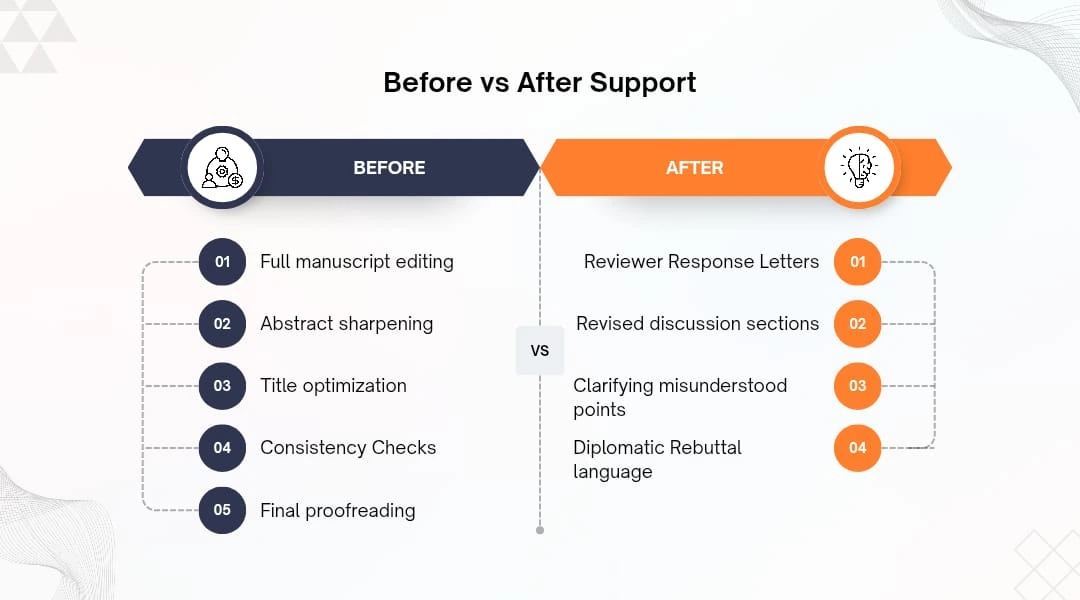
For Thesis-to-Paper Conversion
Use support when converting dissertations into concise journal manuscripts.
For New Authors
Use edited drafts as learning material. Compare original vs edited versions.
What to Avoid
Avoid services that promise:
- Guaranteed acceptance
- Fake peer review
- Predatory journal placement
- Ghostwritten research
- Fabricated citations
Use support for quality—not shortcuts.
Why Institutions Should Care Too
Language barriers do not only hurt individuals. They hurt universities, research centers, and entire countries.
When scholars cannot publish internationally, institutions lose:
- Global visibility
- Rankings influence
- Collaboration networks
- Funding opportunities
- Knowledge transfer potential
Countries investing in research but neglecting communication support waste talent.
Smart institutions now provide:
- Research writing workshops
- Editing subsidies
- Publication mentoring
- English communication programs
- Reviewer response coaching
This is not cosmetic spending. It is a research infrastructure.
A great laboratory without strong communication systems underperforms globally.
The Future of Research Is Global and Multilingual
Over time, academic publishing may become more multilingual. Translation tools may improve. Journals may broaden language policies.
That would be positive progress.
But today, researchers still operate in a system where clear English communication strongly affects discoverability and acceptance.
Until structural change arrives fully, language support remains practical and valuable.
It helps bridge present inequality while broader reforms evolve.
International researchers should not have to choose between waiting for fairness and succeeding now.
They can pursue both.
Final Verdict: Strong Science Needs Strong Communication
The modern publication race is not won by ideas alone. It is won by ideas that are clearly expressed, ethically presented, and quickly understood.
That is why Language Support helps international researchers compete.
It reduces preventable rejection. Instead, it improves the reviewer experience. It increases visibility. And, it builds confidence. It helps excellent science travel beyond borders.
Most importantly, it ensures that language does not silence talent.
If your research is valuable, your writing should help it move—not hold it back.
In a crowded global system, clarity is no longer optional.
It is competitive power.
Ace this journey with Paperedit and its blogs guiding you at every step.