


Choosing the right journal is not guesswork—it’s pattern recognition.
If you’re not systematically studying what a journal has already published, you’re gambling with your submission. And in academic publishing, that gamble usually ends in rejection.
To analyze previously published papers is to reverse-engineer editorial decisions. It’s about decoding what gets accepted, what gets ignored, and why. If you do it right, you stop submitting blindly—and start submitting strategically.
Review the guide How to Submit a Research Paper for Publication for stepwise navigation of all publication steps.
Why Analyzing Previously Published Papers Is Non-Negotiable
Most authors skim journal scopes and move on.
That’s a mistake.
Editorial boards don’t just follow scope statements—they follow trends, preferences, and evolving priorities. The only reliable way to understand those is by studying previously published work in that journal.
According to the National Institutes of Health (NIH), aligning your manuscript with a journal’s prior publications significantly increases acceptance probability.
That’s not theory—it’s observed publishing behavior.
If your paper doesn’t look like it belongs, it won’t be treated like it belongs.
Follow these steps:
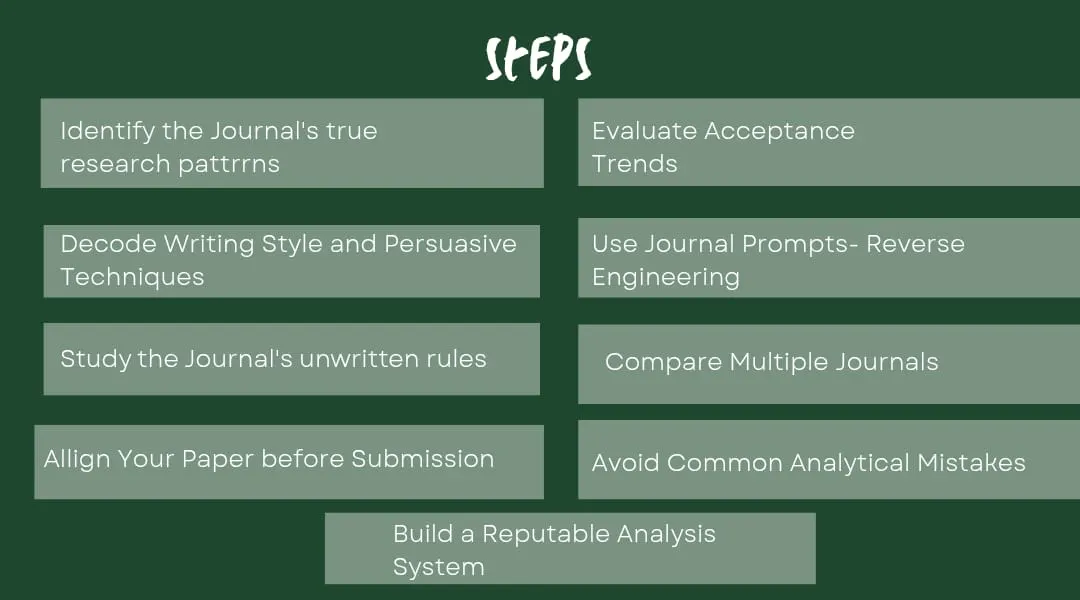
Step 1: Identify the Journal’s True Research Pattern
Forget what the journal claims to publish. Look at what it actually publishes.
Start with the last 2–3 years of articles. Focus on:
- Study design (RCTs, case reports, systematic reviews)
- Sample sizes and geographic focus
- Level of novelty vs replication
- Methodological depth ( learn more from Most Common Mistakes in Research Methodology Sections (And How to Avoid Them))
This is where most authors fail—they assume their topic fit is enough.
It’s not.
For example, if a journal in public policy consistently publishes data-heavy econometric analyses, your qualitative narrative paper—even if relevant—will feel out of place.
To sharpen this skill, you can review structured evaluation strategies through resources like
content analysis frameworks, which help you systematically break down patterns across multiple papers.
Step 2: Decode Writing Style and Persuasive Techniques
This is where things get subtle—and powerful.
Editors don’t just assess what you say. They assess how you say it.
Look at:
- Abstract structure (direct vs narrative) (review this guide: How to Write an Abstract: A Step-by-Step Guide)
- Strength of claims
- Use of citations vs original argumentation
- Tone: cautious, assertive, or policy-driven
If you’ve ever practiced analyzing persuasive techniques in real-world settings, the same principles apply here—except now it’s in academia.
Ask yourself:
- Do accepted papers make bold claims or stay conservative?
- Are conclusions tightly data-bound or interpretive?
- How do authors position novelty?
You’ll notice patterns quickly. Some journals reward confident, forward-looking claims. Others punish anything that sounds speculative.
Matching this tone is not optional—it’s strategic alignment.
Step 3: Study the Journal’s “Unwritten Rules”
Every journal has invisible filters.
You won’t find them in author guidelines—but they show up clearly in accepted papers.
Look for:
- Preferred referencing styles beyond formatting
- Typical word counts (real, not stated) (For further assistance, review How to Reduce Word Count in Academic Papers Without Losing Meaning)
- Figures vs text density
- Funding disclosures and affiliations
For example, journals tied to journals on public administration often favor policy relevance over theoretical abstraction. If your paper doesn’t connect to real-world governance implications, it risks being ignored.
For a deeper understanding of how editorial policies evolve, you can explore insights from
World Health Organization publishing standards, which highlight the increasing emphasis on transparency and applicability.
Step 4: Evaluate Acceptance Trends Through Open Access Publishing News
Publishing is shifting fast—and journals are evolving with it.
Following open access publishing news isn’t just industry gossip—it’s strategic intelligence.
| Open-access journals | Traditional journals |
| Prioritize accessibility and broader impact | Highly specialized contributions |
| Accept interdisciplinary work more readily | Conservative methodologies |
| Expect clearer public-facing implications | Established research paradigms |
You can stay updated through credible platforms like Nature’s publishing news section, which frequently reports on editorial trends and policy shifts.
If you ignore these trends, you risk submitting a paper that feels outdated—even if your research is solid.
Step 5: Use Journal Prompts to Reverse-Engineer Expectations
Think of each published paper as a response to an implicit “journal prompt.”
Your job is to figure out what that prompt is.
Ask:
- What question is this journal repeatedly trying to answer?
- What gaps is it prioritizing?
- What kind of impact does it reward?
This approach turns passive reading into active analysis.
If you’ve ever used journal prompts in writing—or even worked on a junk journal—you already understand the concept: prompts shape output.
Academic journals are no different.
They just don’t state their prompts explicitly.
Step 6: Compare Multiple Journals Before Deciding
One of the biggest mistakes authors make is falling in love with a single journal too early.
Instead, analyze 3–5 target journals side by side.
Create a quick comparison:
- Acceptance style
- Article types
- Writing tone
- Audience focus
You’ll often find that your paper fits better somewhere else—even if your initial choice seemed perfect.
Step 7: Align Your Paper Before Submission—Not After Rejection
Most authors only adjust their manuscript after rejection. That’s inefficient.
If you properly analyze previously published papers, you can pre-align your work before submission.
That includes:
- Adjusting your introduction to match the journal tone
- Structuring your discussion like accepted papers
- Calibrating your claims to fit editorial expectations
If your paper doesn’t naturally align, forcing it later rarely works.
For practical editing strategies, you can explore our professional editing services that focus on journal-specific alignment rather than generic proofreading.
Step 8: Avoid Common Analytical Mistakes
Even when authors try to analyze journals, they often do it poorly.
Here’s what to avoid:
1. Over-relying on scope statements
They’re broad and often outdated.
2. Ignoring rejected article patterns
If you can access them (e.g., preprints), they reveal just as much as the accepted ones.
3. Focusing only on recent articles
Look at consistency over time—not just current trends.
4. Copying structure blindly
Adapt, don’t imitate.
Step 9: Build a Repeatable Analysis System
Don’t treat this as a one-time task.
Create a simple system you can reuse:
- Save 10–15 relevant papers per target journal
- Annotate patterns (style, structure, tone)
- Track editorial trends over time
- Update your analysis before each submission
This turns journal selection into a repeatable process—not a guessing game.
If you’re working across multiple submissions, tools, and workflows, discussed in Academic writing improvement strategies can help streamline your analysis and adaptation.
Final Take: Stop Guessing, Start Decoding
Academic publishing rewards precision—not effort alone.
If you’re not actively studying previously published work, you’re submitting in the dark.
To analyze previously published papers is to understand editorial psychology.
It’s how you shift from hoping for acceptance to engineering it.
The difference is simple:
- Guessing leads to rejection.
- Analysis leads to alignment.
- Alignment leads to publication.