


Turning scattered academic work into a Scopus-indexed publication isn’t about luck — it’s about structure, discipline, and editorial precision. Most researchers fail not because their ideas are weak, but because their research portfolio is chaotic, underdeveloped, or poorly presented.
This guide breaks down exactly how to move from a raw research portfolio to a Scopus publication — ethically, strategically, and without shortcuts.
What “Research Portfolio to Scopus Publication” Actually Means
A research portfolio is more than a folder of drafts. It’s a system — a collection of:
- Unpublished manuscripts
- Conference abstracts
- Data sets
- Literature reviews
- Ongoing collaborations
But here’s the harsh truth: Scopus doesn’t care about effort — it cares about output quality and consistency.
To move from portfolio to publication, you need to:
- Identify publishable units
- Refine them to journal standards
- Match them with the right indexed journal
- Execute ethical submission and revision
If your portfolio isn’t structured, you’re not “building research” — you’re hoarding it.
For a deeper understanding of how indexing systems evaluate research, refer to the Wikipedia overview.
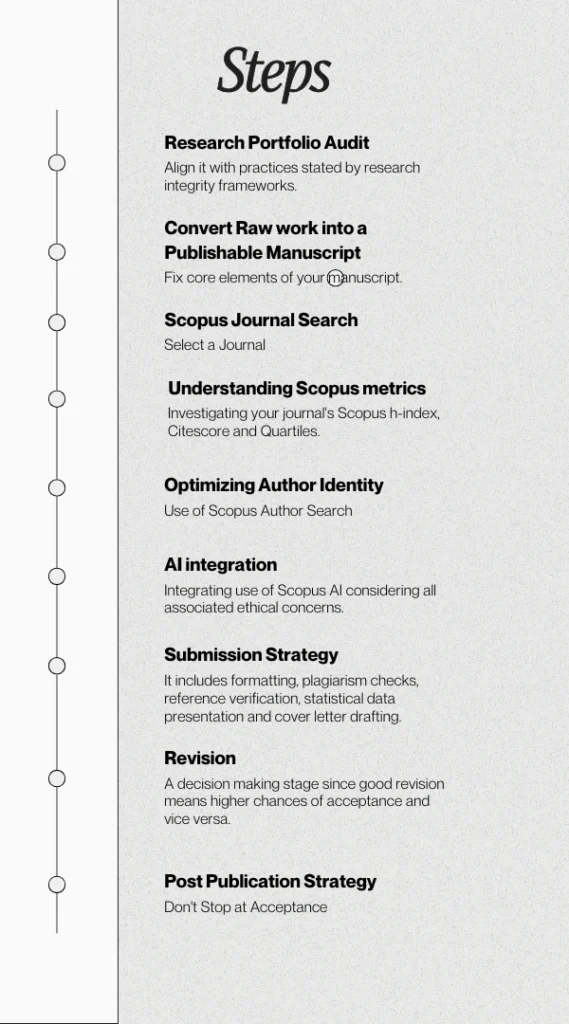
Step 1: Audit Your Research Portfolios Like an Editor
Before thinking about submission, audit your research portfolios brutally.
Ask:
- Which projects have complete data?
- Which ideas solve a clear research gap?
- Which drafts can realistically meet peer-review standards?
- Which studies are outdated or no longer relevant?
Create three categories:
- Ready for editing
- Needs data or restructuring
- Not publishable (yet)
Most early researchers overestimate their readiness.
Don’t do that.
A structured portfolio audit aligns with best practices discussed in research integrity frameworks.
Pro Insight
Think like a journal editor, not a student. Editors don’t evaluate effort — they evaluate clarity, novelty, and reliability.
If your work doesn’t meet those criteria, it doesn’t move forward.
Step 2: Convert Raw Work into a Publishable Manuscript
This is where most portfolios collapse.
Having research is not the same as having a paper.
To move forward, focus on editing your text to a professional level for publication.
Core Elements You Must Fix
- Clarity of hypothesis — your research question must be sharp, not vague
- Logical flow (IMRaD structure) — Introduction, Methods, Results, Discussion must connect seamlessly
- Statistical accuracy — weak analysis will get flagged immediately
- Citation integrity — incorrect or outdated references weaken credibility
Weak editing is one of the top reasons manuscripts get desk-rejected.
If you’re unsure how to refine academic writing properly, this guide on How to Improve Logical Flow in Research Papers breaks down practical editorial techniques.
Red Flags That Kill Your Paper
- Overloaded introductions with no focus
- Methods that can’t be replicated
- Results without interpretation
- Discussion sections full of speculation
- Poorly structured abstracts
Editing isn’t cosmetic — it’s scientific correction.
Advanced Editing Layer
At a higher level, strong manuscripts also demonstrate:
- Narrative consistency (no contradictions across sections)
- Clear data storytelling (not just reporting numbers)
- Alignment between objectives and conclusions
If your paper reads like disconnected sections, reviewers will reject it — even if the data is solid.
Step 3: Use Scopus Journal Search Strategically
Submitting blindly is a rookie mistake.
Use Scopus journal search to identify the right journal — not just any indexed one.
Go to Scopus and analyze:
- Journal scope
- Acceptance rate (if available)
- Recent publications
- Citation patterns (Read The Role of Google Scholar Citations in Academic Reputation)
- Article processing timelines
Match Your Paper With:
- Similar methodologies
- Comparable study populations
- Aligned research themes
- Comparable article types (original, review, short communication)
A mismatch guarantees rejection — even if your research is strong.
For practical journal selection strategies, you can also explore How to Find Free Scopus-Indexed Journals
Reality Check
A high-impact journal is not always the right journal.
Submitting beyond your paper’s scope wastes months — sometimes years.
Step 4: Understand Scopus Metrics Before Submission
You’re not just submitting a paper — you’re entering a ranking ecosystem.
Key metrics include:
Scopus h-index
- Measures both productivity and citation impact
- Grows over time with consistent publishing
- Influences funding, promotions, and collaborations
CiteScore & Quartiles
- Q1 journals = highest impact and strictest review (Read How to Find Q1 Scopus Journals (Step-by-Step Researcher Guide)
- Q2–Q3 = balanced competitiveness
- Q4 = accessible but lower visibility
Why This Matters
Publishing in a random indexed journal doesn’t build authority.
Strategic placement does.
For a deeper insight into publication metrics, refer to PubMed Central.
Strategic Positioning Tip
Early in your career, consistency matters more than prestige.
Build a publication base first — then aim for higher quartiles.
Step 5: Optimize Your Author Identity with Scopus Author Search
Many researchers ignore this — a big mistake.
Once published, your work is tracked through Scopus author search.
This means:
- Your name must be consistent across all publications
- Affiliations must be accurate and updated
- ORCID integration should be active
If your profile is fragmented, your citations are split, damaging your Scopus h-index.
Learn how to build a strong author profile with How to Create a Research Portfolio to Boost Your Career.
Common Author Profile Issues
- Multiple name spellings
- Missing publications
- Incorrect affiliations
- Duplicate profiles
Fixing these early ensures your research impact is fully recognized.
Step 6: Integrate AI Carefully (Scopus AI & Ethical Use)
Yes, Scopus AI and other tools are changing research workflows.
But here’s the reality:
AI can assist with:
- Literature summarization
- Language refinement
- Reference organization
- Grammar correction
AI cannot:
- Generate valid data
- Replace critical thinking
- Justify conclusions
- Interpret complex results reliably
Improper use leads to ethical violations — and journals are actively screening for this.
According to guidelines discussed by organizations like the World Health Organization, maintaining transparency in research writing is non-negotiable.
Ethical Use Checklist
- Disclose AI usage if required by the journal
- Never fabricate or manipulate data
- Always verify AI-generated outputs
- Maintain full responsibility for content
AI should enhance your work — not replace your intellectual input.
Step 7: Submission Strategy That Actually Works
Once your manuscript is ready, don’t rush the submission.
Before You Submit:
- Format according to journal guidelines
- Run plagiarism checks
- Verify references manually
- Ensure figures and tables meet standards
- Prepare a strong cover letter
Writing a Strong Cover Letter
Your cover letter should:
- Clearly state the research contribution
- Explain why the journal is a good fit
- Highlight novelty and relevance
- Maintain a professional tone
Follow this checklist:
| During Submission | After Submission |
| Follow the journal system carefully | Expect revisions — not acceptance |
| Upload all required documents | Track your submission status |
| Suggest relevant reviewers (if required) | Be patient but responsive |
For a step-by-step breakdown, see this guide: Research Cover Letter Checklist.
Step 8: Revision Is Where Publication Happens
Most papers don’t fail at submission — they fail at revision.
Reviewer comments are not attacks. They are filters.
Strong Revision Approach:
- Address every comment individually
- Use a response-to-reviewers document
- Highlight changes clearly
- Support responses with evidence
Weak Revision Approach:
- Ignoring critical feedback
- Making partial changes
- Responding emotionally
- Resubmitting without explanation
Your ability to revise determines whether your research gets published — not just its originality.
For revision techniques, How to Respond to Reviewer Comments Without Destroying Your Manuscript helps you in revision techniques
Pro Tip
Even critical reviewers are giving you a roadmap.
If you follow it carefully, your paper becomes stronger — not weaker.
Step 9: Post-Publication Strategy — Don’t Stop at Acceptance
Getting published is not the end.
It’s the beginning of your research visibility.
After Publication:
- Share your paper on academic platforms
- Update your institutional profile
- Link your work to ORCID and Scopus
- Engage with citations and discussions
Why This Matters
A published paper that no one reads or cites has limited impact. Visibility drives citations — and citations build your Scopus h-index.
Smart Promotion Channels
- ResearchGate
- Google Scholar (Read The Role of Google Scholar Citations in Academic Reputation)
- Academic conferences
- Institutional repositories
Publishing without promotion is wasted potential.
Common Mistakes That Block Scopus Publication
Let’s be direct.
These mistakes destroy your chances:
- Submitting unfinished research
- Choosing journals based on ease, not relevance
- Poor editing of text for publication
- Ignoring journal guidelines
- Misusing AI tools
- Weak response to reviewers
- Inconsistent author identity
If you recognize yourself, fix it before submission — not after rejection.
Final Takeaway: Build Systems, Not Just Papers
Moving from a research portfolio to a Scopus publication is not a one-time process.
It’s a repeatable system:
- Build structured research portfolios
- Convert work into high-quality manuscripts
- Target the right journals using Scopus journal search
- Understand metrics like Scopus h-index
- Optimize your profile with Scopus author search
- Use tools like Scopus AI responsibly
- Execute ethical submission
- Revise with precision
- Promote your published work
Do this consistently, and your publications won’t just increase — your academic credibility will compound.
No shortcuts. No hacks. Just disciplined, high-quality research execution.