


In academia, your title is not decoration. It is positioning.
Before the abstract is read, before the methodology is judged, before citations accumulate — your research title decides whether your work earns attention or is silently ignored. In 2025, where digital indexing, AI-driven search tools, and rapid content scanning dominate scholarly behavior, writing a powerful research title is no longer optional. It is strategic.
A weak title hides strong research. A sharp one amplifies it.
Let’s break down the science — and the art — behind crafting a title that works.
Why Writing a Powerful Research Title Is Academically Strategic
A research title performs three critical functions:
- Signals relevance
- Improves discoverability
- Establishes authority
Search engines, journal databases, and indexing systems rely heavily on title keywords. Platforms like Google Scholar and indexing standards outlined by the National Library of Medicine (NLM) scan titles first when ranking research visibility.
This means your title is not just creative writing — it is metadata.
According to documentation from the International Committee of Medical Journal Editors (ICMJE), clarity and accuracy in titles are essential to prevent misleading interpretation. That’s not stylistic advice. It’s ethical guidance.
If your title exaggerates, oversimplifies, or hides variables, you compromise academic integrity.
What Makes a Research Paper Title Page Matter
Many researchers obsess over wording but ignore structure.
The research paper title page is not a formality. It reflects professionalism and compliance. Journals and universities follow formatting standards such as those documented on APA Style (Wikipedia) and other citation frameworks.
A complete title page research paper typically includes:
- Concise, centered title
- Author names and affiliations
- Institutional information
- Corresponding author details
- Running head (if required)
But here’s the deeper issue:
If your title itself is bloated, vague, or stuffed with filler phrases, no formatting style can save it.
Your structure must support clarity — not compensate for confusion.
If you're unsure how formatting impacts credibility, our guide on The Future of Academic Publishing in the AI Era explains how structural presentation influences peer-review outcomes.
The Anatomy of Writing a Powerful Research Title
A powerful title usually balances four elements:
- Precision
- Clarity
- Keywords
- Specificity
Let’s compare.
Weak Title:
"An Investigation of Social Media"
Improved Title:
"Impact of Short-Form Video Content on Adolescent Attention Span: A Cross-Sectional Study"
The difference?
- Defined population
- Clear variable
- Study design transparency
- Search-friendly phrasing
Effective headline writing techniques 2025 are not about making titles dramatic. They’re about making them searchable and scientifically honest.
A strong title often follows this pattern:
Main Topic + Key Variable + Population + Method (if relevant)
Not all titles need every element. But every word must earn its place.
For deeper structural refinement strategies, our editorial breakdown at Paperedit shows how tightening phrasing increases clarity without increasing word count.
Visual Framework: Strong vs Weak Research Titles
Observe how high-impact titles:
- Avoid vague phrases like “A Study of”
- Replace general terms with measurable constructs
- Eliminate redundant wording
- Prioritize clarity over complexity
Precision reads as authority.
Common Mistakes That Kill Research Visibility
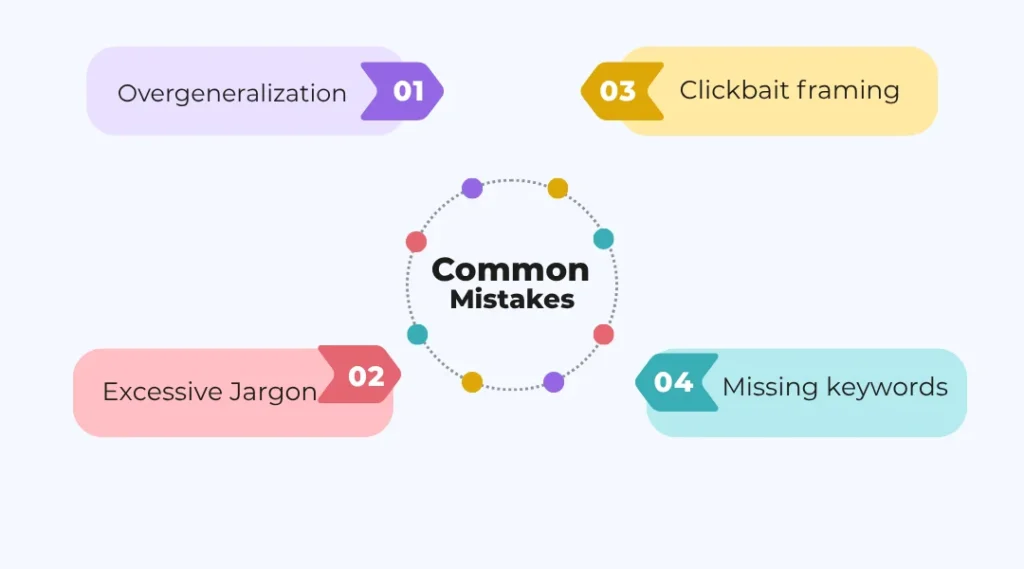
Let’s be direct. Most titles fail because of one of these issues:
1. Overgeneralization
“Effects of Technology on Society”
Too broad. Too unspecific. Not index-friendly.
2. Excessive Jargon
If a multidisciplinary reviewer cannot understand your title in one read, it needs revision.
3. Clickbait Framing
Academic writing is not YouTube. Sensational claims undermine credibility.
4. Missing Keywords
In 2025, failing to integrate searchable terminology reduces discoverability. Tools may suggest phrasing — but human judgment must lead.
If you rely on automated support, understand its limits. While a research paper title maker or research title generator can provide drafts, they cannot assess disciplinary nuance or ethical precision. That distinction is critical.
How to Balance Creativity and Compliance
Academic writing is not meant to be dull. It is meant to be clear.
The best titles combine:
- Conceptual sharpness
- Structural discipline
- Linguistic simplicity
For example:
Descriptive Title:
"Prevalence of Burnout Among Resident Physicians in Urban Teaching Hospitals"
Analytical Title:
"Predictors of Burnout in Urban Resident Physicians: A Multicenter Regression Analysis"
Both are strong — but the second signals methodological depth.
That level of transparency improves trust.
Organizations like the World Health Organization emphasize clarity in reporting public health data because ambiguity distorts interpretation. Research titles operate under the same principle.
Clarity protects credibility.
The Role of AI Tools in Title Development
Yes, tools exist.
Yes, they can accelerate brainstorming.
But no serious scholar should outsource judgment.
A research title generator might suggest keyword variations. A research paper title maker might restructure phrasing. These tools are ideation aids — not editorial authorities.
The risk?
- Keyword stuffing
- Inflated claims
- Artificial phrasing
- Misalignment with study design
Your title must reflect your actual methodology and findings. If your study is observational, your title cannot imply causation. Ethical writing matters.
How Writing Paper Titles Impacts Citation Rates
Data consistently show that clearer, more specific titles correlate with improved citation performance. Why?
Because discoverability drives readership.
Readers search by:
- Population
- Method
- Outcome
- Field
If your writing paper title does not include those cues, your work becomes invisible in databases.
It is not about length — it is about informational density.
Avoid:
- Filler words
- Redundant introductions
- Ambiguous phrasing
Instead, aim for:
- 10–18 meaningful words
- One clear focus
- Zero unnecessary adjectives
Strong titles are lean. Not flashy.
A Practical Framework for Writing a Powerful Research Title
Use this step-by-step refinement model:
Step 1: Write the simplest descriptive version
State exactly what your study did.
Step 2: Remove empty phrases
Delete “A Study of,” “An Investigation into,” “Exploring.”
Step 3: Add methodological clarity (if useful)
Cross-sectional? Randomized trial? Meta-analysis?
Step 4: Insert searchable terminology
Use standard field vocabulary.
Step 5: Read it aloud
If you need to pause to interpret it — revise it.
The Ethical Responsibility Behind a Research Title
A title is not marketing copy.
It is a scientific commitment.
Misleading phrasing can:
- Inflate perceived findings
- Overstate causation
- Reduce reproducibility trust
According to guidance published by the National Institutes of Health (NIH), transparent reporting ensures scientific reliability. Your title is the first transparency checkpoint.
If the study is limited — say so.
And if the sample is small — reflect that.
If the findings are associative — avoid causal language.
Ethical precision builds long-term authority.
Final Thoughts: Authority Begins With the First Line
Writing a powerful research title is about discipline, not decoration.
It requires:
- Strategic keyword placement
- Structural integrity
- Ethical accuracy
- Editorial restraint
In 2025’s saturated academic ecosystem, clarity is competitive advantage.
A powerful title does not shout.
It signals confidence.
If your research matters, your title must reflect that — sharply, honestly, and without unnecessary noise.
Because in academia, the first impression is permanent.
For successful acceptance of your research paper, then read How to Write Abstract Research Paper?