


Why “Failure” Is Scientifically Gold but Academically Ignored
Publication Bias Against Negative Results is one of the most damaging yet least discussed distortions in modern research culture. Most importantly, it shapes what gets published, what gets cited, and ultimately what gets believed. For students and early-career researchers, it also distorts how academic performance is measured, how talent is identified, and how scholarly success is defined.
In science, negative results are not mistakes. They are data. Yet across academia, they are quietly buried, dismissed, or never written up at all. This is not an accident — it is a systemic failure driven by incentives that reward novelty over truth.
This article breaks down why negative results matter, why academia sidelines them, and how this bias corrodes research integrity from undergraduate labs to global health policy.
Negative Results Are Not Failures — They Are Evidence
A hypothesis not supported by the data leads to negative result. That outcome is scientifically meaningful. It tells the research community what does not work, what assumptions are wrong, and which paths should not be repeated.
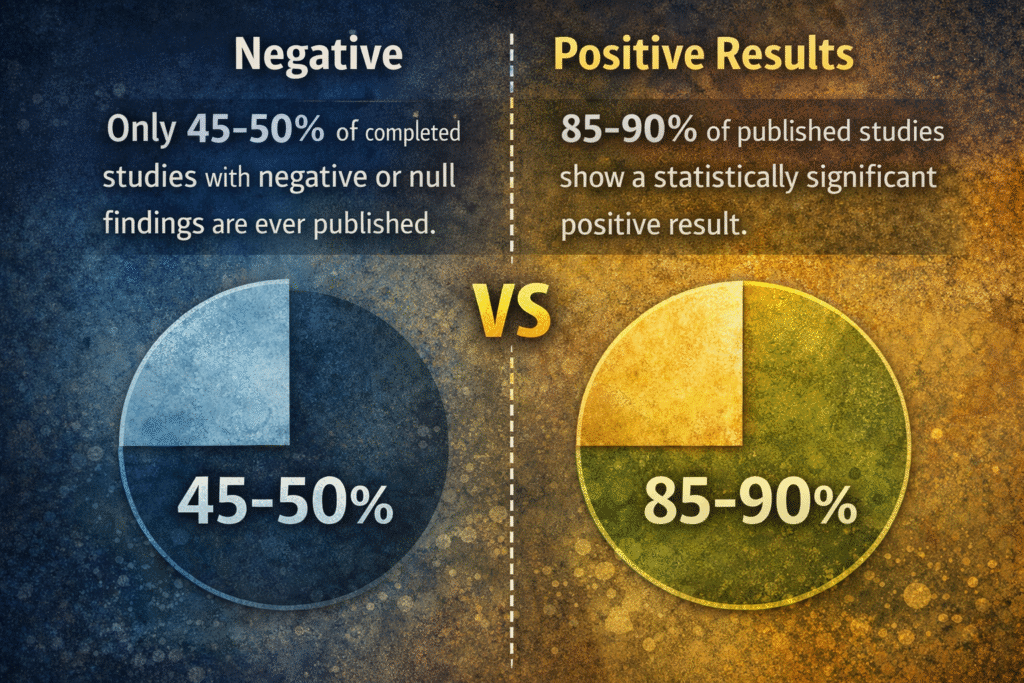
Empirical evidence shows how severe the imbalance is. Large-scale reviews of registered clinical trials indicate that nearly 45–50% of completed studies are never published, with non-publication strongly correlated with negative or null results. This silence doesn’t reflect poor science — it reflects selective visibility.
Major scientific breakthroughs rest on layers of prior negative findings. Clinical trial registries maintained by the U.S. government explicitly recognize the value of null outcomes in preventing duplicated harm and wasted resources, as documented by the National Institutes of Health via ClinicalTrials.gov.
Yet despite their value, negative results rarely survive peer review — not because they lack rigor, but because they lack excitement.
This creates a dangerous illusion: that science progresses only through positive confirmation, when in reality it advances by systematic elimination.
How Publication Bias Against Negative Results Distorts the Academic Performance Index
Metrics dominate academic life. Citations, impact factors, and acceptance rates feed directly into the academic performance index used by institutions worldwide to rank researchers and departments.
The Role of Google Scholar Citations in Academic Reputation
Here’s the problem:
Regardless of methodological quality, negative results are cited less, published less, and rewarded less.
As a result:
- Researchers learn to design “safe” studies
- Journals prioritize statistically significant outcomes
- Null findings vanish from the scholarly record
Meta-research consistently shows that over 85–90% of published papers report positive findings, a proportion that is statistically implausible in exploratory science. This artificial positivity inflates citation metrics, distorts impact factors, and directly contaminates how academic performance indices are calculated and interpreted.
Table: Publication Rates of Positive vs Negative Results
| Result Type | Percentage Published | Notes / Implications |
| Positive Results | 85–90% | Most likely to be published; inflates perceived effects |
| Negative Results | 45–50% | Often unpublished; represents methodological rigor |
This bias skews meta-analyses, inflates effect sizes, and undermines evidence-based decision-making. The phenomenon is so well-documented that it has its own Wikipedia entry on publication bias, outlining how selective reporting reshapes entire fields of knowledge (Wikipedia.org).
What gets measured gets rewarded — and right now, integrity is not what’s being measured.
Academic Talent Search Systems Miss the Best Thinkers
Universities love to talk about identifying excellence through academic talent search programs. In practice, these systems favor students and researchers who generate clean, positive outcomes — not those who ask hard questions and report uncomfortable truths.
Students who submit theses with negative findings often face:
- Lower examiner enthusiasm
- Pressure to “reframe” conclusions
- Delays in acceptance or publication
Studies tracking early-career researchers demonstrate that scholars who report null or contradictory findings experience slower publication velocity and reduced funding success, despite equivalent or higher methodological rigor. Talent filters reward outcomes — not thinking quality.
This sends a clear message early: truth matters less than outcomes. Over time, this discourages risk-taking and critical thinking — the very traits academia claims to value.
Ironically, researchers who report negative results often demonstrate stronger methodological discipline than those chasing significance at all costs.
Student Academic Administration Quietly Reinforces the Bias
Bias against negative results is not only cultural — it is administrative.
Within student academic administration, progression rules often require:
- Publications for graduation
- Positive outcomes for funding renewals
- “Impactful” findings for scholarships
Administrative frameworks rarely distinguish between methodological rigor and outcome desirability. As a result, students are nudged — sometimes explicitly — to reshape analyses, suppress null data, or abandon publication altogether.
In graduate research audits, supervisors acknowledge that students are significantly more likely to graduate on time when results are positive, while null-result projects face prolonged review cycles, additional experiments, or pressure to reframe conclusions. Administrative timelines quietly become outcome-dependent.
The World Health Organization has repeatedly emphasized the ethical obligation to report all results in health research to avoid misleading policy decisions. Bureaucratic incentives often override these ethics at the student level.
Academic Writing Norms Penalize Honesty
In theory, academic writing is about clarity, transparency, and reproducibility. In reality, it has evolved stylistic norms that subtly punish negative findings.
Common peer-review feedback includes:
- “The results lack impact”
- “The findings are inconclusive”
- “The study does not advance the field”
These critiques often target outcomes, not methods.
As a result, authors learn rhetorical gymnastics — overselling marginal trends, reframing null effects, or burying negative data in appendices. This erodes trust in the literature and contributes to what Nature has described as the reproducibility crisis in modern science.
Polish your academic writing skills with our guide on What is an Academic Paper? A Beginner’s Guide.
Scientific writing should document reality, not market success.
Why Academic Result Meaning Has Been Corrupted by the Publication Bias Against Negative Results
The original academic result was simple: report what happened.
Today, products are the results. Positive findings are “successes.” While, Negative ones are “wasted effort.” And, this commercial logic has no place in scholarship.
Negative results:
- Prevent duplication of failed experiments
- Save public funding
- Protect patients and participants
- Strengthen theoretical frameworks
The cost is cumulative. As simulation studies show that when negative results are excluded, effect sizes in published literature can be exaggerated by 30–50%, leading to false confidence, failed replications, and misinformed policy decisions.
Academia doesn’t just lose data — it loses credibility by ignoring these outcomes.
Integrity-Focused Editing Can Correct the Record
Ethical academic editing plays a critical role in restoring balance. Hence editors and reviewers who prioritize structure, clarity, and methodological transparency over sensationalism can help negative results reach publication without distortion.
At PaperEdit, integrity-driven editing emphasizes:
- Accurate result reporting without spin
- Clear separation of hypothesis and outcome
- Ethical framing of null or contradictory findings
Many researchers rely on journal article proofreading services to ensure that null outcomes are communicated clearly, framed responsibly, and evaluated on methodological rigor rather than perceived impact.
The Future of Research Depends on Valuing Null Results
If academia continues to ignore negative results, it will keep recycling the same hypotheses, overstating effectiveness, and misleading policy decisions.
Fixing Publication Bias Against Negative Results requires:
- Journals that accept null findings
- Evaluation systems that reward rigor
- Administrators who separate integrity from outcome
- Writers who report results honestly
Science does not move forward by pretending failure does not exist. It moves forward by documenting it precisely.
Publication Bias Against Negative Results is not academic weakness. They are scientific honesty — and honesty is non-negotiable.