


You spent months designing the study. Then, you collected the data. You ran the stats, revised the manuscript twelve times, and got your co-authors to finally agree on the abstract. And then — you submitted on a random Tuesday afternoon in August because the paper felt "ready."
That might've been your biggest mistake.
Submission timing is one of the least discussed, most impactful variables in academic publishing. It doesn't appear in your methods section. It won't show up in peer review comments. But it quietly determines who reads your work, how fast it gets reviewed, and whether it lands in a high-traffic issue or disappears into a quiet quarterly nobody opens.
This isn't speculation. There's real, growing evidence — from editorial behavior patterns to citation analytics — that when you submit matters almost as much as what you submit.
The Proof Research Community Is Finally Catching On
For years, submission timing was folklore. Senior academics passed it down informally: "Don't submit in December," or "Always aim for the January intake." But the proof research community has started taking this more seriously, and quantitative data is backing up the anecdotes.
Studies tracking editorial workflows at major journals have found that manuscripts submitted during high-volume periods — holiday seasons, conference months, fiscal year-ends — face longer review timelines, higher desk rejection rates, and less attentive editorial handling. This isn't malice. It's capacity.
According to research published on PLOS ONE, submission volume peaks dramatically during certain months, and the correlation between high submission volume and increased rejection rates is statistically meaningful. When editors are overwhelmed, borderline papers don't get the benefit of the doubt — they get desk-rejected.
If you're serious about your manuscript getting a fair shot, treating submission timing as a variable you actively control is not optional. It's strategic.
How Submission Timing Affects Peer Review Speed
Here's the mechanism most researchers don't think about: journals don't have infinite reviewers sitting idle. When your manuscript lands in an editor's inbox, they need to identify two or three qualified peer reviewers, contact them, negotiate availability, and follow up when they go silent. This process alone can take weeks.
Now imagine that process happening in late November, when academics are finishing semester grading, traveling for conferences, or already mentally checked out for the holidays. Your reviewers decline. Your editor sends more invitations. Your review timeline stretches from 6 weeks to 14 weeks — not because your paper was weak, but because the timing was off.
The National Institutes of Health has documented similar patterns in grant review cycles, where applications submitted in crowded cycles receive less individualized attention. The parallel to journal submissions is direct: review quality is partly a function of reviewer bandwidth, and reviewer bandwidth is partly a function of when you asked.
Optimal submission windows — typically February through April, and September through October — align with periods when academics have returned from breaks, aren't buried in grading, and haven't yet entered the conference season sprint. These windows aren't magic; they're just when the ecosystem breathes.
To know more about peer review, read Understanding the Peer Review Process: How It Works and How to Respond.
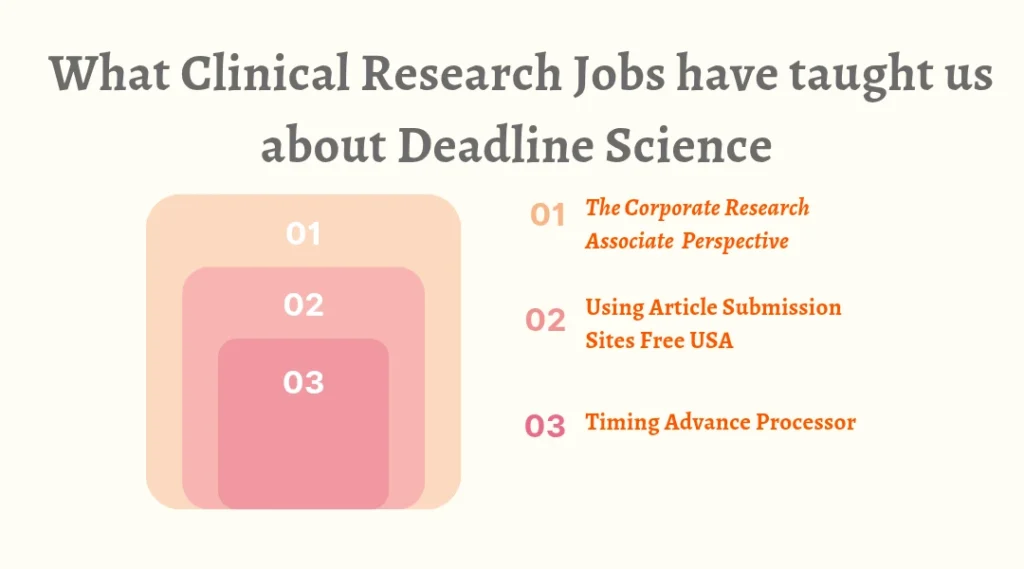
What Clinical Research Jobs Have Taught Us About Deadline Science
People working in clinical research jobs understand deadline discipline better than almost anyone in academia. Clinical trial submissions, IRB renewals, regulatory filings — these operate on hard schedules where timing isn't a preference, it's a compliance requirement.
That culture of timing precision bleeds into publication behavior. Researchers with clinical research backgrounds tend to plan submission schedules months in advance, treat journal intake cycles the way they'd treat a protocol submission window, and build buffer time into every stage of manuscript preparation.
The lesson for academic writers outside clinical fields? Borrow that discipline. Map out your target journal's editorial calendar. Check whether they have special issues with submission deadlines. Find out if they publish continuously or in discrete issues. Then work backward from your ideal publication date and build a submission timeline — not a submission impulse.
If you're newer to research and exploring research assistant jobs, this kind of structured thinking will differentiate you immediately. Hiring managers in research environments value people who understand workflow sequencing, not just content quality.
The Corporate Research Associates Perspective: Timing as Competitive Intelligence
Corporate research associates — professionals embedded in industry R&D, market research, or policy think tanks — operate in environments where publication timing is a literal competitive strategy. Publishing before a competitor. Timing a white paper to drop during a legislative session. Releasing data to align with a product launch.
This sounds mercenary, but the academic world has its own version of this dynamic. Submitting to a journal before a competing research group publishes similar findings can establish priority. Timing your submission to appear in a special issue can dramatically boost readership and citation potential. Releasing a preprint strategically before formal submission can stake your intellectual territory.
The idea that academics operate outside strategic timing calculus is a myth. The most cited researchers in any field are often the ones who understood that positioning a paper matters as much as polishing it.
At PaperEdit, we've worked with hundreds of researchers across disciplines, and the pattern is consistent: manuscripts that reach us with a submission timeline already in mind almost always perform better than those submitted "whenever it's done."
Using Article Submission Sites Free USA: Timing Still Applies
One area where timing discipline often breaks down is preprint and open-access platforms. Researchers treat these as pressure valves — when a paper is rejected or still in revision, they dump it on a preprint server and consider the timing obligation met.
That's a mistake.
Even on article submission sites free USA platforms like SSRN, bioRxiv, or OSF Preprints, timing affects discoverability. Social media amplification of preprints tends to cluster around academic conference periods. Search indexing and cross-referencing on these platforms rewards papers that go live when traffic is high — typically when researchers are actively looking for new literature to cite.
The Wikipedia entry on preprint servers notes how rapidly the preprint ecosystem has grown, particularly post-2020. That growth means more competition, not less. Posting a preprint in a dead week is the digital equivalent of releasing a press release on Christmas Eve.
If you're going to use these platforms — and you should — treat them with the same timing intelligence you'd apply to a formal journal submission. Check conference calendars. Post when your field is actively engaged. Cross-promote strategically.
Timing Advance Processor: The Technical Analogy That Actually Explains This
In processor architecture, a timing advance processor manages signal timing to optimize system performance — ensuring that signals arrive at precisely the right moment, not too early and not too late. The entire purpose is to synchronize inputs with system readiness.
The analogy to manuscript submission is uncomfortably precise.
Your research is the signal. The journal ecosystem — editors, reviewers, readers — is the system. And the timing advance processor is your submission strategy: the mechanism that ensures your signal arrives when the system is most ready to receive, process, and amplify it.
When your signal arrives off-cycle — during a noisy, high-volume period when the system is saturated — it gets queued, delayed, or dropped. When it arrives in sync with system capacity, it moves efficiently through the pipeline.
This isn't just a metaphor. PaperEdit's manuscript editing services: Proofreading and formatting services consistently incorporate calendar-aware submission coaching because we've seen what happens to polished, well-argued papers that land at the wrong moment. They wait. They accumulate desk rejections. They get revised without any structural problem existing. The problem was timing.
A Submission Timing Strategy Table: Month-by-Month Breakdown
Here's a practical guide to academic submission timing across the calendar year. This is based on observed editorial patterns in STEM, social sciences, and humanities journals.
| Month | Submission Climate | Risk Level | Strategic Notes |
| January | High editor availability post-holidays | Low | Strong window; reviewers fresh and engaged |
| February | Peak productivity period | Very Low | Ideal; editors and reviewers fully active |
| March | Conference abstract deadlines crowd attention | Medium | Submit early in the month to avoid the rush |
| April | Pre-conference sprint begins | Medium | Reviewers may begin traveling; plan ahead |
| May | End-of-semester grading crunch | High | Faculty reviewers overwhelmed; risky window |
| June | Summer begins, reduced availability | High | Desk rejection risk elevated significantly |
| July | Peak low-activity period | Very High | Avoid unless journal publishes continuously |
| August | Gradual return, mixed availability | High | Wait for September if manuscript allows |
| September | Strong post-summer return to work | Low | Second-best window of the entire year |
| October | High engagement, pre-conference season | Low | Excellent timing; journals actively seeking |
| November | Conference season peaks globally | Medium-High | Be selective with journal choice |
| December | Holiday slowdown begins | Very High | Avoid; reviewer decline rates spike sharply |
Use this table as a working framework, not a rigid rule. Some journals — particularly high-volume, continuously publishing outlets — are less sensitive to seasonal variation. But for smaller specialty journals and society publications, this calendar pattern is highly predictive.
What Research Assistant Jobs Teach You About Timing Literacy
If you're in a research assistant job or transitioning into one, timing literacy is one of the underrated competencies that senior researchers notice immediately. It's not just about submission windows — it's about understanding the rhythm of academic production.
Knowing when grant cycles close. Knowing when conference deadlines create manuscript rushes. Knowing when faculty supervisors are cognitively available to review your drafts versus when they're grading or traveling. All of this is timing literacy, and it makes you a sharper collaborator, a more efficient researcher, and — eventually — a more strategic independent scholar.
The best research assistants don't just execute tasks. They anticipate timing dependencies and plan around them. That instinct, developed early, compounds over a career.
The Ethics of Strategic Submission Timing
Let's be direct about something: strategic timing is not manipulation. It's not gaming the system. It's not the same as citation farming, duplicate submission, or data fabrication.
Choosing when to submit a legitimately prepared, ethically conducted manuscript is no different than a journalist choosing when to publish a story for maximum impact. The content hasn't changed. The integrity hasn't changed. You're simply making an informed decision about when to release work into a system that you understand.
What would be unethical is submitting a paper simultaneously to multiple journals to hedge your timing bets — a practice called duplicate submission that COPE (Committee on Publication Ethics) explicitly prohibits. Or inflating authorship to boost visibility. Or misrepresenting the submission date.
Strategic timing, by contrast, requires no ethical compromise. It simply requires awareness — of editorial cycles, reviewer availability, seasonal patterns, and platform behavior.
For further details, read Ethical Challenges in Multi-Center Research.
Making This Practical: A Submission Timeline Checklist
Before you hit submit on your next manuscript, run through this:
- Have you checked the journal's editorial calendar? Special issues, themed volumes, and rotating editorial boards all affect timing.
- Is it a high-volume submission period? December, May, and July are statistically riskier windows.
- Have you prepared your preprint strategy? If you're posting to a free USA submission platform, is the timing coordinated with a conference or social media push?
- Is your manuscript editing complete? PaperEdit's professional editing team can turn around polished manuscripts faster than most researchers expect — don't let "it's not ready yet" cost you an optimal window.
- Have you given yourself buffer time? Submitting the day before a holiday or a major conference is asking for delays.
Timing without quality is irrelevant. Quality without timing is inefficient. Both together is what separates consistently published researchers from the ones who wonder why their work isn't getting the traction it deserves.
The Bottom Line: Stop Treating Submission Timing as an Afterthought
The academic publishing ecosystem is not a neutral, infinitely available infrastructure that processes submissions at identical speeds regardless of when they arrive. It's a human system — run by editors who get tired, reviewed by scholars who get busy, and read by audiences who follow seasonal attention patterns.
Submission timing is your interface with that human system. Treat it like data. Study it. Plan around it. And stop submitting on instinct when you could be submitting on strategy.
Your research deserves a fair reading. Give it the best chance of getting one.
Reference Books
- Writing for Scholarly Publication by Anne Sigismund Huff (Sage Publications) — A foundational text on the strategic and structural dimensions of academic publishing, including workflow and submission planning.
- How to Write a Lot: A Practical Guide to Productive Academic Writing by Paul J. Silvia (American Psychological Association) — Covers time management, submission scheduling, and productivity systems for researchers at all career stages.