


You’ve read your paper ten times. It feels logical. Clean. Obvious, even.
Then the reviewer comments arrive—and suddenly your “clear” manuscript is labeled confusing, vague, or poorly structured.
That gap isn’t bad luck. It’s a predictable cognitive failure in academic writing. And if you don’t understand it, no amount of editing will fully fix your paper's clarity.
This article breaks down exactly why this happens—and how to correct it with precision, not guesswork.
1. The Illusion of Clarity: Why Authors Overestimate Their Writing
Most researchers don’t struggle with knowledge; they struggle with translation.
You know your topic too well. That’s the problem.
This is known as the curse of knowledge. Once you understand something deeply, your brain skips explanatory steps unconsciously. What feels obvious to you is invisible to a first-time reader.
A widely cited explanation can be found in cognitive psychology research, as summarized on Wikipedia’s page on the curse of knowledge, where experts consistently overestimate the comprehensibility of their explanations.
In academic writing, this leads to:
- Missing logical steps
- Undefined assumptions
- Overcompressed explanations
- Weak transitions
- Implicit conclusions instead of explicit ones
You’re not being unclear on purpose. Your brain is editing for itself, not for your reader.
2. What Reviewers Actually Mean by “Lack of Clarity.”
When reviewers criticize clarity, they’re rarely talking about grammar.
They’re pointing to structural and cognitive issues that weaken your entire argument.
| Reviewer Comment | What It Actually Means | Impact on Paper |
| “Unclear argument” | Your logic jumps steps | Weak credibility |
| “Methods not well described.” | Missing procedural detail | Irreproducible research |
| “Discussion is vague.” | No strong interpretation | Low impact |
| “Poor organization” | Ideas are not sequenced logically | Reader confusion |
| “Needs clarity” | The reader must work too hard to understand | Risk of rejection |
Clarity is about reducing reader effort. If your reader has to pause, re-read, or guess—your paper has failed at clarity.
According to guidance from the National Institutes of Health, research communication must be precise and reproducible—clarity is essential for scientific integrity, not just readability.
3. The Real Cost of Poor Paper Clarity
Let’s be direct: lack of clarity doesn’t just annoy reviewers—it kills papers.
Here’s what happens behind the scenes:
- Reviewers lose trust in your results
- Editors question your methodological rigor
- Your contribution appears weaker than it actually is
- Your citations and theoretical framing get overlooked
- Your acceptance probability drops significantly
Even strong research gets rejected if it’s not clearly communicated.
A report from the National Science Foundation emphasizes that clarity directly affects how research is evaluated and funded.
Clarity is not cosmetic. It’s strategic.
4. Where Clarity Breaks Down in a Research Paper
Clarity issues are not random. They show up in predictable sections.
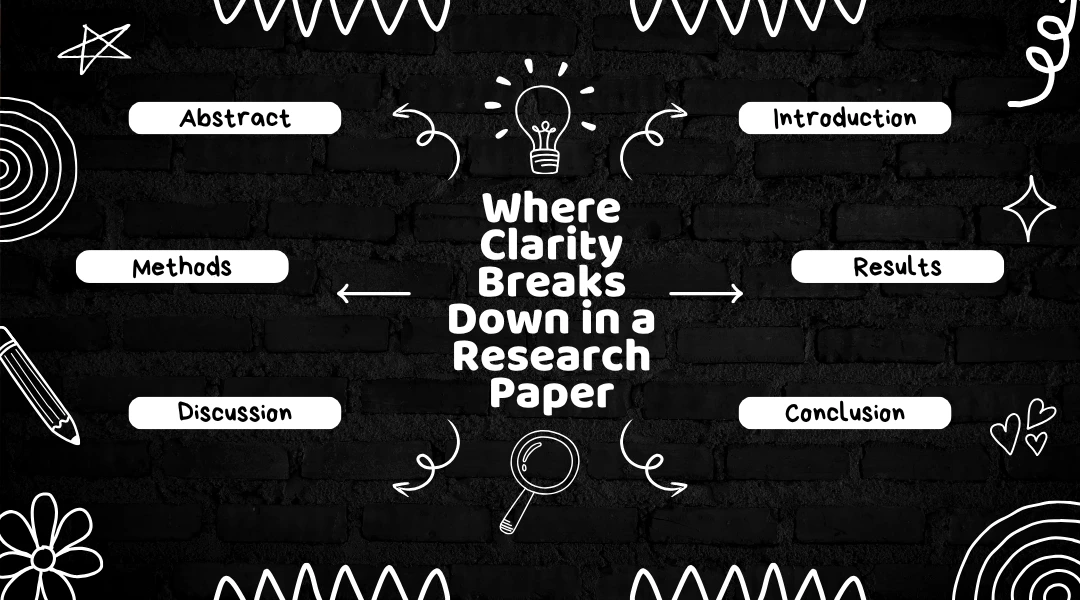
Abstract
- Overloaded with jargon
- No clear takeaway
- Missing research gap
Introduction
- Weak or missing problem statement
- No defined research gap
- Overly broad context
Methods
- Missing replication details
- Assumes reader familiarity
- No justification of choices
Results
- Data presented without interpretation
- Tables without explanation
Discussion
- Repeats results instead of analyzing them
- No connection to existing literature
Conclusion
- No clear contribution
- Weak implications
If your paper feels “clear” to you, check whether each section answers a specific reader question. If not, you’re writing for yourself, not your audience.
Let’s break this down sharply.
5. The Difference Between “Clear to You” vs “Clear to Others.”
| Aspect | Clear to You | Clear to Reviewer |
| Context | Already known | Must be introduced |
| Logic | Internal | Explicitly shown |
| Terms | Familiar | Defined |
| Flow | Intuitive | Structured |
| Evidence | Assumed | Justified |
| Purpose | Obvious | Must be stated |
This is why even a strong research paper example can feel confusing if it assumes background knowledge.
Clarity is not about intelligence—it’s about reader awareness.
6. How Structure Fixes Most Clarity Problems
If your paper lacks clarity, the issue is usually structural—not linguistic.
A strong structure forces clarity.
Start with a solid outline.
Before writing, define:
- What question are you answering?
- What gap are you filling?
- What is your key contribution?
- What is your argument flow?
Using a clear framework, like writing a research paper outline, dramatically reduces confusion later.
You can refer to structured guidance entitled 'How to Improve Logical Flow in Research Papers' when building your draft.
A good research paper outline example ensures:
- Logical sequencing
- No missing steps
- Clear argument progression
- Smooth transitions
Without structure, clarity is impossible.
7. Practical Clarity Benefit Solutions That Actually Work
Forget generic advice like “write simply.” That’s ineffective.
Here are real clarity benefit solutions that work in academic writing:
1. Force Explicit Logic
Every claim must answer:
- Why is this true?
- How do we know this?
If the answer isn’t written, your paper lacks major clarity.
2. Define Before You Use
Never introduce technical terms without explanation.
This is essential when using:
- Statistical models
- Interdisciplinary frameworks
- New theoretical constructs
3. Break Down Complex Sentences
Long sentences hide confusion.
Bad:
“The study, while addressing multiple variables under constrained conditions, demonstrates significant improvements.”
Better:
“The study examines multiple variables. Under limited conditions, the results show clear improvement.”
For further clarity, refer to these guides:
- Understanding Wordiness in Academic Research
- How to Reduce Word Count in Academic Papers Without Losing Meaning
4. Use Reader Signals
Guide your reader explicitly:
- “This study aims to…”
- “The results indicate…”
- “This suggests that…”
- “In contrast…”
Clarity improves when direction is obvious.
5. Use Examples Strategically
A short research paper example can clarify abstract ideas instantly.
Instead of explaining a concept in theory, show how it works in context.
6. Validate with External Feedback
If someone outside your niche struggles to understand your paper, clarity is missing.
Professional editing services like Paperedit formatting and proofreading services provide that critical external lens.
8. Why Non-Academic Sources Can Damage Clarity
Using non-academic sources for research paper writing often introduces:
- Inconsistent terminology
- Informal tone
- Weak evidence structure
- Lack of methodological rigor
These reduce both clarity and credibility.
For standards on credible sourcing, see the U.S. Government Publishing Office guidelines, which emphasize authoritative and verifiable information.
Clarity depends on consistency. Non-academic sources disrupt that consistency.
9. Ethical Clarity: Why Transparency Matters
Clarity is not just technical—it’s ethical.
A vague paper can:
- Mislead readers
- Hide methodological weaknesses
- Prevent replication
- Reduce trust in findings
This is why including an ethics statement for research paper is essential.
Clear ethical disclosure aligns with global standards such as those discussed by the World Health Organization.
If your paper isn’t clear, it isn’t fully ethical.
10. What High-Clarity Papers Do Differently
A strong sample research paper doesn’t just present findings—it guides the reader step by step.
High-clarity papers:
- State the research question early
- Define key terms immediately
- Follow a logical structure
- Explain methods in full detail
- Interpret results clearly
- Connect findings to broader implications
You can explore professionally refined manuscripts at Paperedit's blogs section to see how clarity transforms academic writing.
11. The Role of Topic Selection in Clarity
Even your topic affects clarity.
Poorly defined research topics for a research paper lead to:
- Broad arguments
- Weak focus
- Confusing structure
Strong topics are:
- Specific
- Narrowly scoped
- Researchable
- Clearly defined
Clarity starts before writing begins.
12. Clarity vs Complexity: Stop Confusing the Two
Many researchers believe complex writing signals intelligence. It doesn’t.
Complexity without clarity creates:
- Reader fatigue
- Misinterpretation
- Weak engagement
Clarity does not mean oversimplification. It means:
- Precision
- Logical flow
- Accessibility without losing rigor
The best academic papers are not the most complex—they are the most understandable.
13. How Editing Transforms Paper Clarity
Editing is not proofreading. It is a structural refinement.
A proper clarity-focused edit will:
- Reorganize arguments
- Identify logical gaps
- Simplify dense sections
- Strengthen transitions
- Remove redundancy
This is why relying only on grammar tools fails.
Advanced editing services like Paperedit focus on meaning, not just language.
14. Common Clarity Mistakes in Academic Writing
Let’s call them out directly:
- Writing long paragraphs with multiple ideas
- Using jargon without explanation
- Skipping logical steps
- Overusing passive voice
- Presenting data without interpretation
- Weak conclusions
These are not minor issues—they directly impact publication success.
15. A Practical Clarity Checklist Before Submission
Before submitting your paper, ask:
- Can a non-expert understand my introduction?
- Is my research question clearly stated?
- Are all terms defined?
- Is my method reproducible?
- Do my results include interpretation?
- Does my conclusion clearly state the contribution?
If any answer is “no,” your clarity needs work.
16. Final Reality Check: Clarity Is a Skill, Not a Talent
Here’s the truth most researchers avoid:
If reviewers say your paper lacks clarity, they’re right.
Not because your research is weak—but because your communication is incomplete.
Clarity is built through:
- Structured thinking
- Strategic outlining
- Iterative revision
- External feedback
- Professional editing
It’s not optional. It’s the difference between rejection and publication.
References
- National Institutes of Health (NIH). (2025, April 24). The basics: NIH clinical research trials and you. U.S. Department of Health and Human Services. Retrieved May 7, 2026, from https://www.nih.gov/health-information/nih-clinical-research-trials-you/basics
- Wikipedia Contributors. (2024). Curse of knowledge. Wikipedia, The Free Encyclopedia. Retrieved May 7, 2026, from https://en.wikipedia.org/wiki/Curse_of_knowledge