


Peer review can feel brutal, but it’s a filter for quality, not a personal attack. Knowing how to respond to reviewer comments strategically and ethically ensures your manuscript paper improves, rather than collapses under feedback.
Learn more about this with NIH in Key Guidelines for Responding to Reviewers.
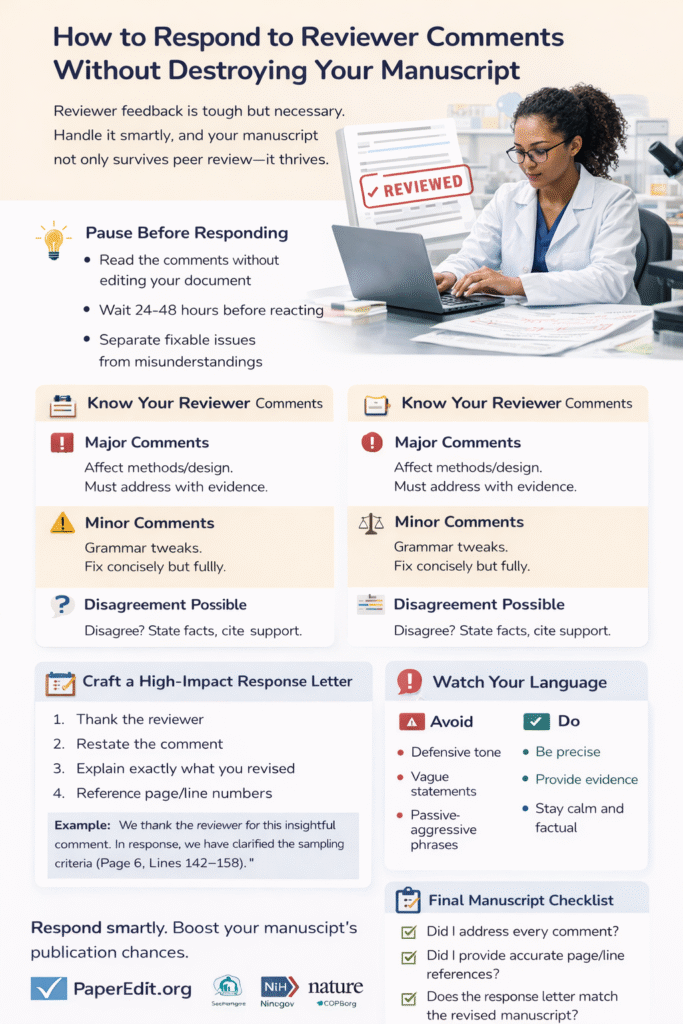
Why Reviewer Comments Are Critical
Most authors misread peer feedback as criticism of their intellect. In reality, reviewers appointed by a scientific review committee assess rigor, clarity, and contribution. Approaching feedback professionally increases acceptance chances and strengthens your research.
Pause Before Responding
Immediate replies often lead to defensive language. To avoid weakening your manuscript:
- Read all comments without editing.
- Wait 24–48 hours before responding.
- Re-read comments neutrally, separating fixable issues from negotiable disagreements.
Types of Reviewer Comments
Understanding comment categories helps prioritize revisions.
| Comment Type | Impact on Manuscript | Recommended Response |
| Major | Affects methodology, study design, or interpretation | Address comprehensively; provide page/line references; cite evidence |
| Minor | Grammar, formatting, references, clarifications | Fix directly; keep responses concise |
| Disagreement Possible | Reviewer misunderstands or suggests optional changes | Politely explain rationale, support with literature |
| Conflicting | Different reviewers give contradictory suggestions | Acknowledge both, justify editorial choice, consult editor if needed |
Table 1: Summary of common reviewer comment types.
Structuring a High-Impact Response Letter
For every comment:
- Thank the reviewer
- Restate the comment
- Explain your revision clearly
- Reference the page/line numbers
Example:
We thank the reviewer for this insightful comment. In response, we have clarified the sampling criteria in the Methods section (Page 6, Lines 142–158).
Avoid vague statements or defensive tone.
Disagreeing Respectfully
Disagreement is allowed if evidence-based. Avoid dismissive phrasing.
- Weak: “The reviewer is mistaken.”
- Strong: “We respectfully disagree and have clarified the rationale in the revised Discussion, supported by recent literature.”
This approach aligns with COPE.org ethical standards and maintains credibility.
Handling Conflicting Comments
Conflicts between reviewers are common:
- Reviewer A: Add more data
- Reviewer B: Shorten the manuscript
Solution: Acknowledge both, justify your editorial decision, and optionally seek the editor’s guidance. Nature’s editorial guidelines suggest transparent reasoning is better than blind compliance.
Formatting and Submission Tips
Clean presentation signals professionalism:
- Submit both tracked-changes and clean manuscripts.
- Label responses by reviewer/comment number.
- Ensure manuscript paper PDF files are named clearly.
Professional editing services—like PaperEdit’s journal article proofreading services—can prevent errors that lead to unnecessary rejection.
Language Pitfalls to Avoid
- Defensive tone
- Passive-aggressive phrasing
- Over-apologizing
- Vague statements
Instead, use precise, accountable language to convey clarity and professionalism.
Final Checklist Before Resubmission
- Address all comments
- Confirm page/line references
- Ensure response letter matches revised manuscript
- Verify adherence to ethical and reporting standards
Many journals use automated checks based on ICMJE.org recommendations.
Responding Well Is a Learned Skill
Mastering how to respond to reviewer comments improves your research impact. Properly handled feedback strengthens argument clarity, methodological transparency, and editorial trust—crucial for long-term academic success.