
Paraphrasing isn’t just a writing trick—it’s a core academic survival skill. If you can’t reframe ideas without distorting meaning or triggering plagiarism flags, your research credibility takes a hit. Period. Whether you’re drafting a thesis, submitting to journals, or managing work under academic probation pressure, mastering how to paraphrase academic content properly is non-negotiable.
This guide breaks it down with zero fluff—what works, what fails, and how to do it like someone who actually understands academic integrity.
What Does It Mean to Paraphrase Academic Content?
Paraphrasing means expressing someone else’s idea in your own words while preserving the original meaning. It’s not about swapping a few words or using synonyms randomly—that’s lazy rewriting, and it often fails plagiarism checks.
In academic contexts, paraphrasing connects directly to originality, clarity, and critical thinking. According to research ethics principles outlined by organizations like the World Health Organization, proper attribution and accurate interpretation are fundamental to scholarly communication
If you’re still asking what is academic performance indicator, understand this: your ability to paraphrase effectively is one of them. It reflects comprehension, not just writing ability. Strong paraphrasing can influence your standing in student academic administration, impact evaluations during academic internships, and even shape how your contributions are valued in peer academic leader circles.
Why Paraphrasing Matters More Than You Think
Here’s the blunt truth: weak paraphrasing exposes weak understanding.
Academic institutions—from undergraduate programs to advanced academic internship council structures—use paraphrasing quality as a signal of intellectual engagement. It impacts:
- Grades and academic performance indicator metrics
- Research credibility
- Publication acceptance rates (Read How Professional Editing Improves Your Chances of Journal Acceptance)
- Risk of plagiarism accusations ( Read Why Avoiding Plagiarism in Research Paper Is Essential for Academic Integrity)
A report by Harvard’s writing program highlights that patchwriting (poor paraphrasing) is one of the most common causes of unintentional plagiarism.
If you're aiming to be seen as a peer academic leader, this is where you prove it. It’s more than writing—it’s a professional habit that distinguishes average performers from high-achieving students in west academic programs and beyond.
The Right Way: How to Paraphrase a Quote Effectively
Let’s get practical. Here’s a clean, structured method that actually works.
Step 1: Fully Understand the Source
Read the original text multiple times. If you don’t understand it, you cannot paraphrase it—end of story. Focus on the context, the claim, and the supporting evidence.
Step 2: Break Down the Core Idea
Strip the sentence to its meaning:
- What is the main claim?
- What evidence or context supports it?
- How does it connect to your argument or research?
Step 3: Rewrite Without Looking
Close the source and write it in your own words. This prevents accidental copying.
Step 4: Compare and Refine
Check:
- Is the meaning intact?
- Is the structure different?
- Are key terms appropriately retained?
Step 5: Cite Properly
Even if you paraphrase perfectly, you still need to cite the source. According to guidelines summarized on Wikipedia’s academic integrity page, failing to credit ideas—even when reworded—is plagiarism.
Bad vs Good Paraphrasing (Clear Examples)
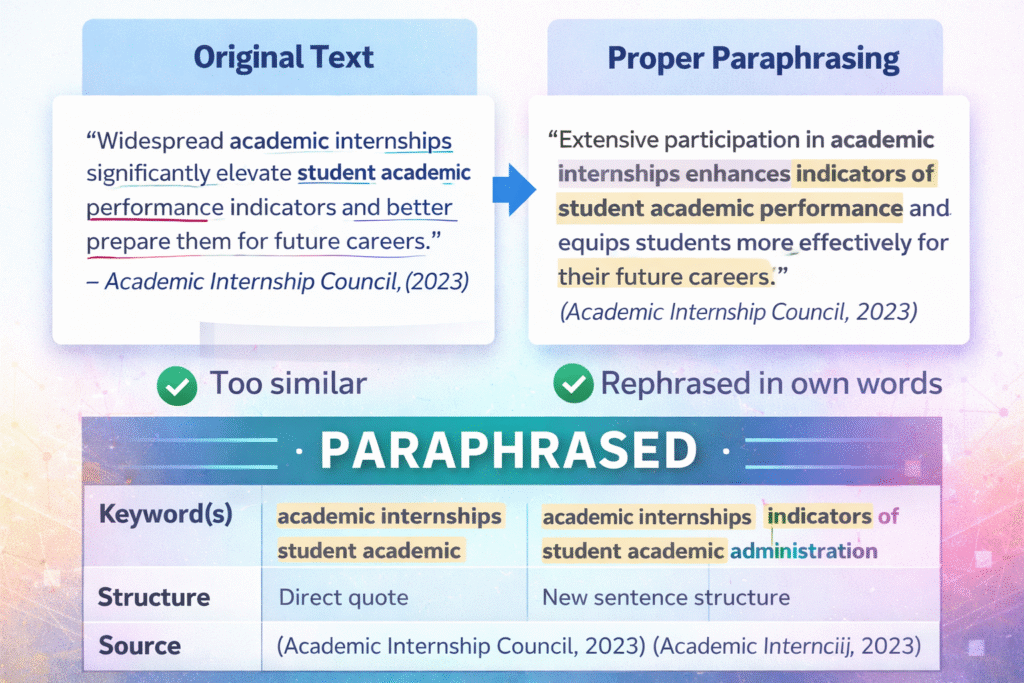
| Original Sentence | Weak Paraphrase | Strong Paraphrase |
| “Academic success depends on consistent engagement, critical thinking, and the ability to synthesize information.” | “Academic success relies on regular participation, critical thinking, and the ability to combine information.” | “Students perform well academically when they actively engage with material, think analytically, and integrate knowledge from multiple sources.” |
| “Research shows that structured feedback improves student outcomes.” | “Studies indicate that organized feedback helps students.” | “Evidence suggests that when students receive structured feedback, their academic outcomes improve significantly.” |
| “Peer collaboration fosters deeper understanding of complex topics.” | “Working with peers helps understand topics better.” | “Collaborating with classmates enhances comprehension and allows students to grasp complex subjects more thoroughly.” |
Notice the difference: strong paraphrases restructure sentences, incorporate your own voice, and maintain accuracy.
Common Paraphrasing Mistakes That Ruin Your Work
Let’s call them out directly:
1. Synonym Swapping
Replacing words without changing structure. This is the fastest way to fail plagiarism checks.
2. Overcomplicating Language
Trying to sound “academic” by using complex words. It usually makes your writing worse.
3. Losing the Original Meaning
If your paraphrase distorts the idea, it’s academically incorrect—even if it’s original.
4. Skipping Citations
Paraphrased content still belongs to the original author.
5. Copying Sentence Structure
Even with different words, identical structure signals poor paraphrasing.
If you’re working under pressure—like during academic probation west academic systems—these mistakes become even more common. That’s when discipline matters most.
Advanced Techniques for High-Level Academic Writing
If you want to move beyond basic paraphrasing and actually stand out:
Use Structural Transformation
Change:
- Sentence order
- Voice (active ↔ passive) ( checkout our guide Active vs. Passive Voice: Which Is Best for Scientific Writing?)
- Clause structure
Integrate Multiple Sources
Instead of paraphrasing one source, combine insights:
“Research suggests that academic performance improves with active engagement and structured learning strategies.”
This shows synthesis—a key trait of a peer academic leader.
Use Reporting Verbs Strategically
Instead of repeating “says,” use:
- argues
- suggests
- highlights
- demonstrates
This adds analytical depth.
Mind Academic Tone
Avoid overly casual phrasing. For example, instead of saying “Students get better at school when they study with others,” say: “Collaborative study practices have been shown to enhance academic performance.”
Tools vs Skills: Don’t Outsource Your Thinking
Yes, paraphrasing tools exist. No, they won’t save you.
Most tools:
- Rewrite mechanically
- Miss context
- Trigger AI or plagiarism flags ( Learn AI vs Human Editing: Which Is Better for Your Manuscript in 2025?)
A study discussed in Nature emphasizes that over-reliance on automated writing tools can reduce critical thinking in academic settings.
If you're serious about improving your academic performance indicator student metrics, build the skill—not dependence.
Paraphrasing and Academic Administration
Strong paraphrasing isn’t just for essays. It permeates academic administration, research reports, and academic internship council documentation. For instance:
- Curriculum reviews rely on accurate paraphrasing of educational research.
- Grant proposals demand synthesis of multiple academic sources.
- Peer academic leader evaluations are influenced by your ability to integrate insights effectively.
Poor paraphrasing can misrepresent data, mislead supervisors, or even jeopardize internships. Developing this skill is essential for anyone navigating academic performance indicator systems or handling administrative reports in higher education.
When NOT to Paraphrase
Paraphrasing isn’t always the best option.
Use Direct Quotes When:
- The wording is unique or powerful
- You’re analyzing language itself
- Precision is critical (e.g., definitions)
Use Paraphrasing When:
- Explaining concepts
- Integrating research
- Avoiding excessive quotations
Balance is key. Over-paraphrasing can dilute authority, while over-quoting kills originality.
Final Takeaway: Paraphrasing Is a Thinking Skill, Not a Writing Trick
If you treat paraphrasing as a shortcut, it will backfire. Every time.
Strong paraphrasing reflects:
- Deep understanding
- Analytical thinking
- Ethical writing (Read Ethical Challenges in Multi-Center Research)
And in modern academia, that’s the difference between average and credible.For more structured support, check resources like PaperEdit academic editing services.